

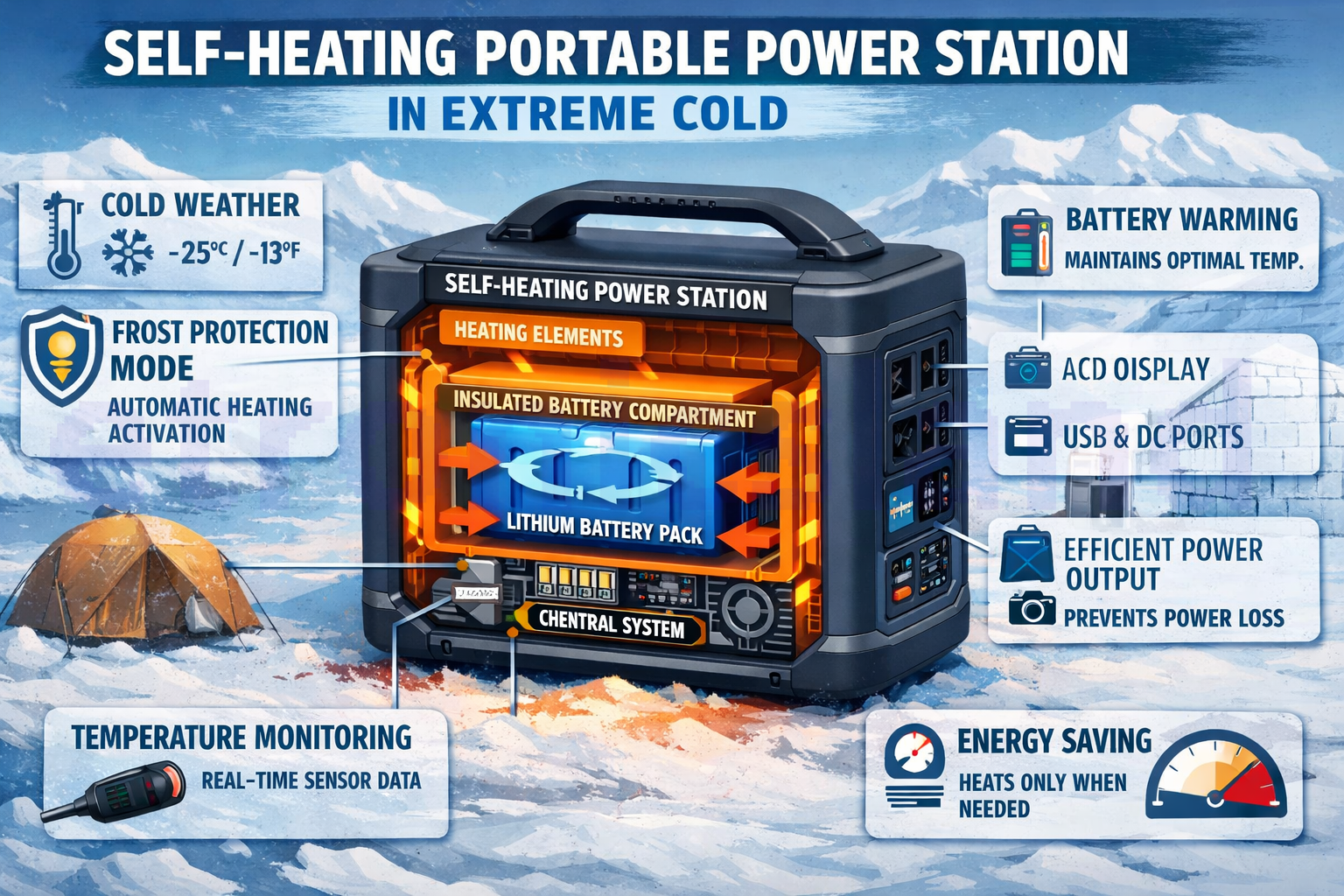
Heated Portable Power Stations
In extreme cold (e.g., below -20°C / -4°F), standard lithium-ion batteries suffer from:
- Reduced capacity (up to 50% loss at -20°C)
- Increased internal resistance
- Inability to charge (charging below 0°C can damage cells)
- Voltage sag leading to premature shutdown
- Potential permanent damage if charged while frozen
Heated portable power stations integrate internal battery warmers (resistive heating elements + thermostats) to keep cells near 10–20°C (50–68°F) even in subzero environments.
Key Differences
| Feature | Standard Power Station | Heated Power Station |
|---|---|---|
| Min charging temp | 0°C (32°F) | -30°C (-22°F) |
| Min discharging temp | -10°C to -20°C | -30°C or lower |
| Capacity at -20°C | ~50% of rated | ~85-95% of rated |
| Self-heating time | N/A | 5–20 min (adjustable) |
| Battery cycle life in cold | Drastically reduced | Maintained near normal |
Performance Comparison (Text-based bar chart)
Usable Capacity at -20°C (% of rated)
fig 1
Standard power station:   [████████░░░░░░░░░░░░] 50%
Heated power station:     [█████████████████░░░] 88%
Max Charge Rate at -15°C
fig 2
Standard:  [██░░░░░░░░] 0.2C (very slow, unsafe)
Heated:    [████████░░] 0.8C (near normal)
How the Heating System Works
fig 3
[Extreme Cold Air -30°C]
         │
         ▼
┌─────────────────────────┐
│  Heated Power Station   │
│  ┌─────────────────┐    │
│  │ Battery Heater  │◄───┤ Thermostat (10°C on/20°C off)
│  │ (resistive film)│    │
│  └────────┬────────┘    │
│           │ Heat        │
│  ┌────────▼────────┐    │
│  │ Li-Ion Cells    │    │
│  │ (kept at 15°C)  │    │
│  └────────┬────────┘    │
│           ▼             │
│  ┌─────────────────┐    │
│  │ Inverter + USB  │    │
│  └─────────────────┘    │
└─────────────────────────┘
Real-World Benefits
| Scenario | Without Heater | With Heater |
|---|---|---|
| Jump-starting a car at -25°C | Battery too weak | Full cranking power |
| Charging via solar in winter | Impossible (cells <0°C) | Heater warms first, then charges |
| Running CPAP machine overnight | Shuts down after 3h | Runs full 8h |
| Emergency radio / satellite device | Voltage sag causes reboot | Stable power |
| Lifespan in arctic use | <200 cycles | >800 cycles |
Energy Cost of Heating (pie chart – approximate)
Heating a 1000Wh station from -30°C to operating temp:
fig 4
Energy used for heating:     [████░░░░░░] 15% (150Wh)
Remaining for devices:       [██████████] 85% (850Wh)
In practice, the heater runs intermittently (e.g., 10% duty cycle after warm-up), costing ~5-10% total capacity in extreme cold — far less than the 50% loss without heating.
When a Heated Model is Essential (checklist)
- ❄️ Temperatures below -10°C (14°F) – charging becomes impossible without heat.
- ❄️ Prolonged outdoor stays (ice fishing, mountaineering, off-grid cabins).
- ❄️ Mission-critical devices (medical, communication, navigation).
- ❄️ Cold vehicle storage – heated models start instantly; others need to warm indoors.
- ❄️ Lithium iron phosphate (LiFePO4) – safer chemistry, but still needs >0°C for charging.
Example Models (not an endorsement)
| Brand | Model | Heated? | Min charge temp |
|---|---|---|---|
| EcoFlow | Delta 2 (w/ extra battery heater accessory) | Optional | -20°C with heater |
| Anker | F2000 (Solix) | No (but low-temp cut-off) | 0°C |
| Bluetti | AC180 (some versions) | No | 0°C |
| Goal Zero | Yeti 1500X (with heated blanket add-on) | External only | 0°C |
| Pecron | E1500LFP (w/ internal self-heating) | Yes | -30°C |