

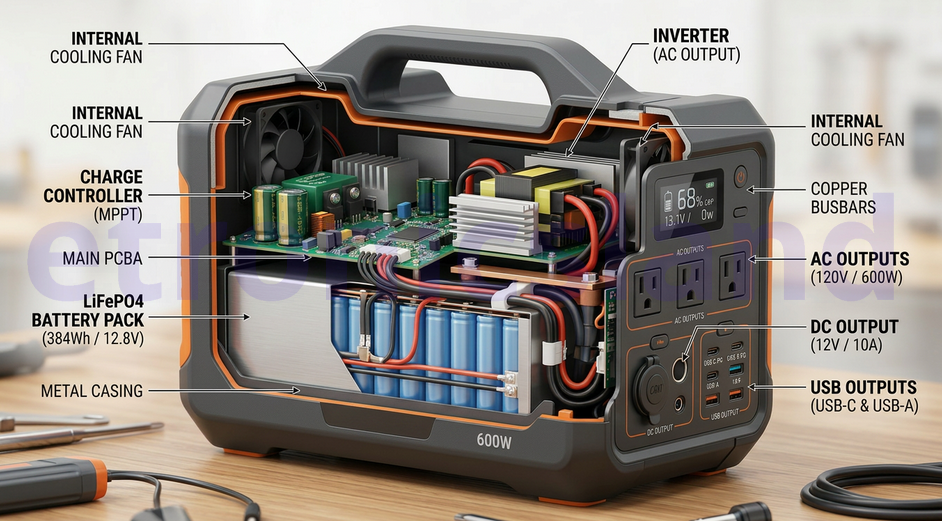
Here is a detailed explanation of how a portable power station works, broken down by its internal components and the flow of electricity.
The Core Idea: A Rechargeable Battery in a Box
At its simplest, a portable power station is a large, sophisticated rechargeable battery packed inside a rugged case, along with electronics to:
- Safely store electricity from a wall outlet, car cigarette lighter, or solar panel.
- Convert that stored electricity into various usable forms (AC like a wall outlet, DC like a car port, USB for phones).
- Protect itself and your devices from overheating, overcharging, short circuits, and excess power draw.
Think of it as a quiet, fume-free, and more complex alternative to a gas generator.
The 5 Key Internal Components
Let’s look at the specific parts and what they do.
| Component | Function |
|---|---|
| 1. Lithium-ion Battery Cells | The energy storage tank (e.g., 500 Wh capacity). |
| 2. Battery Management System (BMS) | The safety and monitoring brain. |
| 3. Inverter | Converts DC battery power to AC wall power. |
| 4. Charge Controller | Regulates incoming power (especially from solar). |
| 5. Control Panel & Ports | The user interface with AC/DC/USB outputs. |
1. The Battery Cells (Energy Storage)
- Chemistry: Most modern stations use Lithium Iron Phosphate (LiFePO4) or Lithium Nickel Manganese Cobalt (NMC) . LiFePO4 is safer and lasts longer (3,000+ cycles), while NMC is lighter for the same capacity.
- Configuration: Hundreds of individual cylindrical or prismatic cells are wired in series and parallel to achieve the desired voltage (typically ~12V to 50V internally) and total capacity (measured in Watt-hours, Wh).
- Example: A 1,000 Wh station can theoretically run a 100W TV for 10 hours.
2. The Battery Management System (BMS) (The Safety Brain)
The BMS is a circuit board that constantly monitors the battery. It prevents:
- Overcharging (stopping charging at 100%).
- Deep discharging (shutting off before voltage drops too low).
- Overheating (using temperature sensors to cut power).
- Short circuits (immediately disconnecting output).
- Cell imbalance (ensuring all cells charge/discharge evenly).
Without a BMS, lithium batteries can catch fire or be permanently damaged.
3. The Inverter (Creating AC Wall Power)
Most household devices (laptops, fans, kitchen appliances) run on Alternating Current (AC) at 110V or 220V. The battery stores Direct Current (DC) at a low voltage (e.g., 12V). The inverter solves this.
- How it works: Electronic switches rapidly flip the DC polarity thousands of times per second, then a transformer boosts the voltage to 110V/220V. The final output is a modified or pure sine wave.
- Pure Sine Wave: Clean, smooth power identical to grid electricity. Safe for sensitive electronics (CPAP machines, medical devices).
- Modified Sine Wave: A choppy, stepped waveform. Can damage some motors and chargers. Avoid this.
- Efficiency: Inverters are 85–95% efficient. If you pull 100W from the AC port, the battery actually supplies ~110W.
4. The Charge Controller (Managing Inputs)
This regulates the power coming into the station from various sources:
- AC (Wall outlet): Simple conversion; the station’s internal AC-to-DC charger converts wall AC to the correct DC voltage to charge the battery.
- Solar panels: This is critical. Solar panels produce varying voltage/current depending on sunlight. A Maximum Power Point Tracking (MPPT) controller continuously adjusts the electrical load to extract the maximum possible power from the panels. Cheaper stations use a less efficient PWM (Pulse Width Modulation) controller.
- Car (12V cigarette lighter): Limits current to a safe level (usually 8-10A) to avoid blowing the car’s fuse.
5. Control Panel & Output Ports
This is what you see and use. It distributes power from the battery and inverter:
- DC Outputs (direct from battery): USB (5V), USB-C (up to 240V with PD), car socket (12V). These don’t use the inverter, so they are more efficient.
- AC Outputs (from inverter): Standard household outlets.
- Screen/App: Shows battery percentage, input wattage, output wattage, and estimated runtime.
The Flow of Electricity: An Example
You want to charge a laptop (needs 60W AC).
Discharging (Powering a device):
- Initiate: You plug your laptop into the station’s AC outlet.
- Conversion: The inverter draws ~68W of DC power from the battery (accounting for 88% inverter efficiency) to create clean 110V AC.
- Monitoring: The BMS checks if the battery has enough charge, if the temperature is safe, and if the laptop is trying to draw too much power.
- Delivery: Clean AC power goes to your laptop. The screen shows ~60W output and estimated remaining minutes.
Charging (From solar panels):
- Initiate: You plug a 200W solar panel into the station’s solar input.
- Regulation: The MPPT charge controller adjusts its circuit to find the optimal voltage/current from the panel (e.g., 18V at 11A = 198W).
- Charging: The controller sends that 198W of DC power at the exact voltage the battery needs (e.g., 14.4V for a 12V battery bank) to charge the cells safely.
- Termination: When the BMS detects the battery is 100% full, it signals the charge controller to stop accepting power.
Important Limitations
- Inverter Power vs. Battery Capacity: A station might have a 1000W inverter (can run a 1000W microwave) but only 500Wh of capacity (would run that microwave only 20-25 minutes before dying).
- Surge Power: Motors (fridges, pumps) need 2-3x their running wattage to start. A station might handle 500W continuous but 1000W surge.
- Usable Capacity: You never get the full rated Wh. Inverter inefficiency, battery heating losses, and the BMS preventing full discharge means you typically get 80-90% of the rated number.
In summary, a portable power station is a tightly integrated system where the battery stores energy, the BMS ensures safety, the charge controller manages refueling, and the inverter creates standard wall power. The magic is in the electronics that seamlessly coordinate all these functions.