

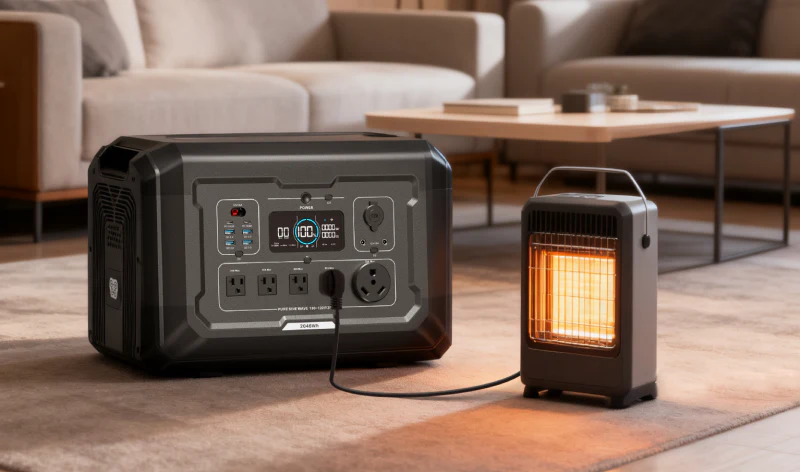
The short answer is yes, technically—but in practice, it is almost always a terrible idea. While a sufficiently powerful portable power station can indeed run a space heater, the physics of electrical resistance heating makes this one of the most inefficient and impractical applications for battery-based power. Below, I provide a detailed analysis of why this is the case, what it takes to do it, and the far better alternatives available.
1. The Fundamental Problem: Energy Density vs. Heat Demand
Space heaters are resistive loads—they convert electricity directly into heat through high-resistance heating elements. This is an inherently inefficient use of battery storage because:
- Heat is energy-intensive: A typical space heater consumes 1,000–1,500 watts continuously while running
- Batteries store limited energy: Even the largest portable power stations (3,000–4,000Wh) can only run a space heater for 2–3 hours before complete depletion
- The math doesn’t work: Heating a room for a full winter night would require 10,000–20,000Wh of battery capacity—far beyond portable units
Real-World Runtime Examples
| Space Heater Wattage | Power Station Capacity | Estimated Runtime (Continuous) |
|---|---|---|
| 1,500W (typical high setting) | 1,000Wh (e.g., EcoFlow River 2 Pro) | 40 minutes |
| 1,500W | 2,000Wh (e.g., Bluetti AC200MAX) | 1.3 hours |
| 1,500W | 3,000Wh (e.g., Jackery Explorer 3000 Pro) | 2 hours |
| 1,500W | 5,000Wh (large expandable system) | 3.3 hours |
| 750W (low setting) | 3,000Wh | 4 hours |
Even with a premium 3,000Wh unit costing over $2,000, you get barely two hours of heat—hardly a practical solution for overnight warmth or extended outages.
2. Technical Requirements for Running a Space Heater
If you still wish to power a space heater from a portable power station, here are the technical requirements.
Inverter Capacity
Space heaters require significant running watts, but they have no surge demand (resistive loads draw the same power at startup as during operation). The power station’s inverter must exceed the heater’s wattage:
| Heater Type | Typical Running Watts | Minimum Inverter Running Watts Required |
|---|---|---|
| Small ceramic fan heater | 750–1,000W | 1,000W+ |
| Standard space heater (high setting) | 1,200–1,500W | 1,500W+ |
| Oil-filled radiator | 600–1,500W | 1,500W+ |
| Baseboard heater | 1,500–2,500W | 2,500W+ |
Most mid-to-large portable power stations (1,500W–3,600W inverters) can technically supply this power. The limiting factor is battery capacity, not inverter capability.
Battery Capacity and Discharge Rate
Running a 1,500W heater draws current at approximately:
- 12V system: 125 amps (beyond most portable station BMS limits—requires 24V or 48V architecture)
- 48V system: 31 amps (within safe limits)
Premium power stations with 48V internal architectures (like the EcoFlow Delta Pro, Bluetti AC500) handle these loads more efficiently than 12V-based units.
3. The Efficiency Trap: Why It’s Worse Than It Looks
Beyond the obvious runtime limitations, there are hidden inefficiencies that make space heater operation even more impractical.
Inverter Efficiency Loss
All power stations experience conversion losses when producing AC power:
- Typical inverter efficiency: 85–92%
- Loss as heat: 8–15% of the battery’s stored energy is wasted as inverter heat before it ever reaches the heater
For a 1,500W heater running for 2 hours, inverter losses alone waste 240–450Wh—enough to charge a laptop 8 times or run an LED TV for 4–5 hours.
Battery Cycle Wear
Discharging a battery at maximum rate accelerates degradation. Running a space heater at full inverter capacity:
- Generates significant internal heat in the battery cells
- Reduces cycle life compared to gentler discharges
- May trigger thermal throttling in hot environments
A $2,000 power station cycled daily to run a space heater will degrade to 80% capacity in 2–3 years instead of 5–10 years with typical usage.
4. Better Alternatives for Heating During Outages
If your goal is staying warm during a power outage or off-grid situation, these alternatives are far more practical than using a portable power station to run a resistive space heater.
Option 1: Propane, Butane, or Kerosene Heaters
| Heater Type | Advantages | Disadvantages |
|---|---|---|
| Propane radiant heater (e.g., Mr. Heater Buddy) | 4,000–9,000 BTU; runs 3–10 hours on a 1lb tank; safe for indoor use with ventilation | Requires ventilation; consumes consumable fuel |
| Kerosene convection heater | 10,000–23,000 BTU; 8–14 hours per gallon | Strong odor; requires ventilation; fuel storage concerns |
| Butane camp heater | Portable; clean-burning; 2–4 hours per canister | Less heat output; fuel canisters are single-use |
A $100 Mr. Heater Buddy running on propane produces 4,000–9,000 BTU—equivalent to 1,200–2,600W of electrical heat—and runs for hours on a single propane tank that costs a fraction of what a comparable battery system would cost.
Option 2: Diesel or Multi-Fuel Heaters
Parking heaters (e.g., Chinese diesel heaters or Webasto/Eberspächer units) are highly efficient, drawing only 10–40W of electricity while producing 5,000–20,000 BTU of dry heat. A small portable power station can run such a heater for days on a single charge, making this the ideal off-grid heating solution.
Option 3: Passive and Low-Tech Solutions
- Insulation: Sealing drafts and insulating windows retains existing heat
- Thermal mass: Heating water in jugs with a propane stove and placing them in rooms provides radiant warmth without electricity
- Layered clothing and sleeping bags: The most energy-efficient heating is personal insulation
Option 4: Electric Blankets (The Efficient Compromise)
If you must use battery power for warmth, an electric blanket is dramatically more efficient than a space heater:
| Device | Power Draw | Runtime on 3,000Wh Power Station |
|---|---|---|
| Space heater (1,500W) | 1,500W | 2 hours |
| Electric blanket (twin) | 50–100W | 30–60 hours |
| Heated mattress pad | 60–150W | 20–50 hours |
An electric blanket or heated throw directly warms a person rather than the entire room, using 5–10% of the energy of a space heater to achieve comfortable warmth.
5. Summary Table: Heating Methods Compared
| Heating Method | Power Source | Typical Output | Runtime / Cost | Efficiency for Off-Grid |
|---|---|---|---|---|
| Resistive space heater | Battery (1,500W) | 5,100 BTU | 2 hours on 3,000Wh | Very Poor |
| Propane radiant heater | Propane (1lb tank) | 4,000–9,000 BTU | 3–10 hours | Excellent |
| Diesel parking heater | Battery (10–40W) + diesel | 5,000–20,000 BTU | Days on small battery | Excellent |
| Electric blanket | Battery (50–100W) | Personal warmth | 30–60 hours | Good |
| Kerosene heater | Kerosene | 10,000+ BTU | 8+ hours per gallon | Good |
6. When Does It Make Sense to Use a Power Station for Heating?
There are narrow scenarios where running a space heater from a portable power station is justified:
| Scenario | Why It Works |
|---|---|
| Brief spot heating | Running a small 600–750W heater for 15–30 minutes to take the chill off a bathroom or small room |
| Abundant solar input | If you have large solar panels (1,000W+) and clear sun, you can run a heater during daylight hours without depleting battery reserves |
| Emergency frost protection | Keeping pipes from freezing in a single night when no other heat source is available |
| Ultra-small space | A 200W personal ceramic heater in a well-insulated van or tent can be viable with adequate battery capacity |
7. Expert Verdict
Can a portable solar power station power a space heater? Yes—technically, any power station with an inverter rated above the heater’s wattage will run it. Should you do it? Almost never.
The energy economics are fundamentally misaligned. Batteries are optimized for storing energy to run efficient devices—LED lights (10–30W), laptops (50–100W), refrigerators (150–300W cycling), and medical equipment. Heating is the single most energy-intensive household function; using precious stored battery power for resistance heating is like using bottled drinking water to wash your car—it works, but it’s a profound misuse of the resource.
If warmth during outages is your priority, invest in a propane heater with proper ventilation, a diesel parking heater for off-grid efficiency, or at minimum, an electric blanket. Reserve your portable power station for what it does best: running lights, communications, refrigeration, medical devices, and electronics. Your battery capacity—and your wallet—will thank you.