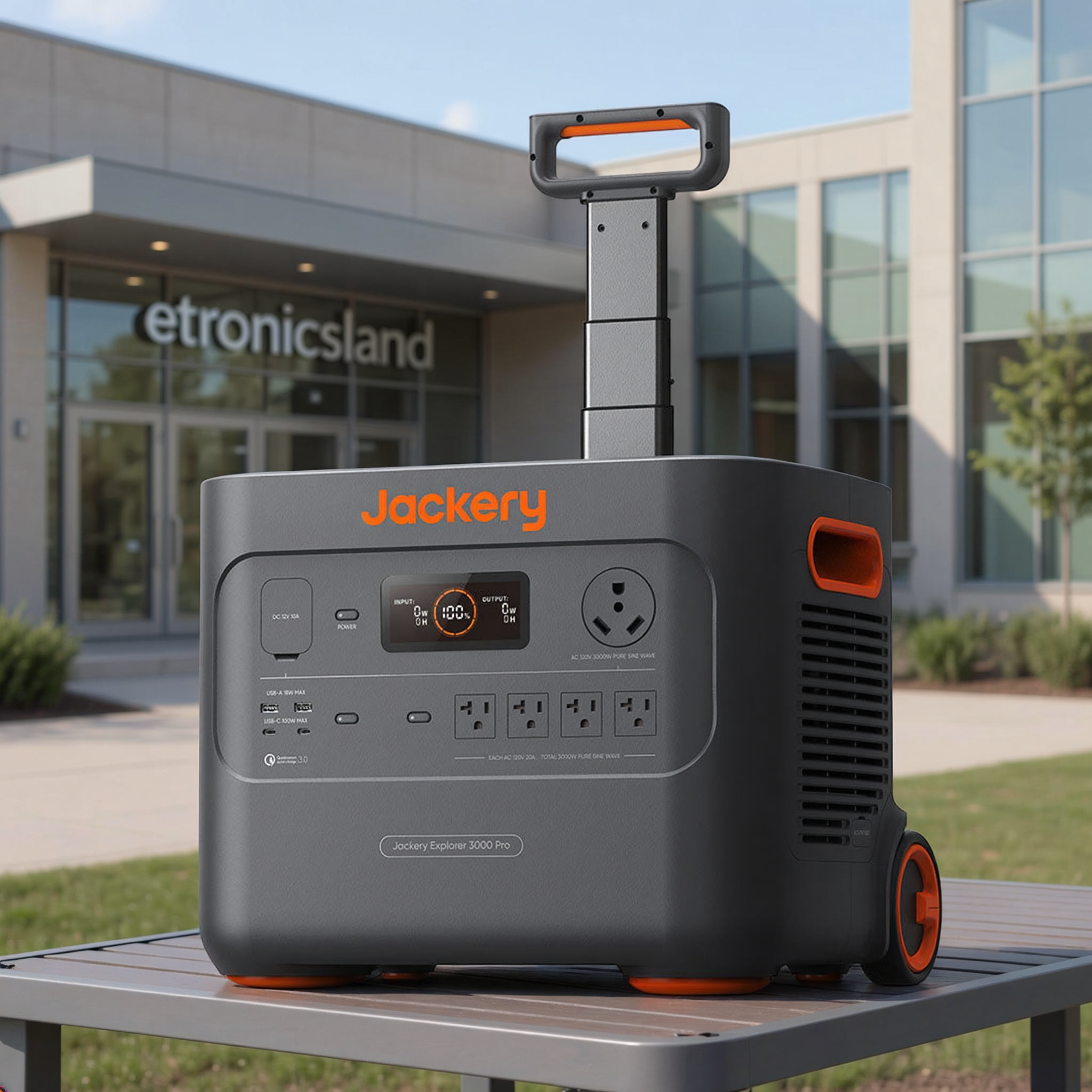
The Jackery Explorer 3000 Pro delivers immense 3,024Wh of capacity and 3,000W of pure sine wave power in a surprisingly mobile package, thanks to its integrated telescoping handle and rugged wheels that make the 63.9-pound unit genuinely rollable. Its standout feature is blazing-fast recharge speeds—0% to 80% in just over an hour via AC or solar, making it exceptionally practical for emergency scenarios where charging windows are limited. However, the unit is hampered by dated NMC lithium-ion battery chemistry, offering only 2,000 cycles compared to the 3,500+ cycles of modern LiFePO₄ competitors, and its non-expandable design prevents capacity upgrades. For users needing a powerful, portable, and quick-charging emergency backup that will see occasional use, it excels—but for daily off-grid living, the shorter lifespan and lack of expansion make competitors like the Bluetti AC200MAX or EcoFlow Delta Pro more compelling long-term investments.
Specs
AC Output: 5 x 120V, 3000W sustained (6000W surge)
USB-C: 2 x 100W Max (5-20V⎓5A)
USB-A: 2 x 18W Max (Quick Charge 3.0)
Car Port: 12V⎓10A Max
AC Input: 1 x 120V, 1800W Max
DC Input (Solar): 2x 8mm Ports, 11-60V, 1400W total
Pros
Excellent Portability: Telescoping handle and durable wheels make moving 63 lbs manageable
Fast Charging: 0-100% in ~2 hours via AC or solar with 1800W/1400W input
Low Idle Draw: Only 7W consumption keeps battery available for standby needs
Reliable 3000W Output: Sustains full-rated power for high-wattage appliances without overheating
Smart App Control: Full remote monitoring and settings via Bluetooth/Wi-Fi
Cons
Dated Battery Chemistry: NMC lithium-ion offers only 2000 cycles vs. LiFePO₄ competitors
Non-Expandable: Cannot add external batteries to increase capacity
Proprietary Solar Connectors: Requires adapters for third-party solar panels
Surge Capacity Overstated: Real-world surge limits around 4500W, not 6000W
No Built-In Light: Unlike competitors, no integrated LED lighting
The Jackery Explorer 3000 Pro is a flagship portable power station designed for serious off-grid living, RV adventures, and whole-home emergency backup. With a massive 3,024Wh lithium-ion battery and a powerful 3,000W pure sine wave inverter (6,000W surge peak), it can run nearly any household appliance you throw at it. What sets this unit apart is its suitcase-style portability—despite weighing a substantial 29 kg (63.9 lbs) , it features a telescoping handle and rugged double wheels that allow you to roll it behind you like a piece of luggage. This mobility is a game-changer for moving power from the kitchen to the workshop or into your RV without straining your back.
However, the Explorer 3000 Pro has notable drawbacks that potential buyers must consider. Most significantly, it uses older NMC (lithium-ion) battery chemistry rather than the modern LiFePO₄ (LFP) found in competitors. While Jackery rates it for 2,000 cycles to 70% capacity, LFP batteries typically offer 3,500+ cycles, meaning this unit will degrade faster if used daily. Additionally, the proprietary 8mm barrel connectors for solar input mean you’ll need adapters to use third-party solar panels, locking you somewhat into Jackery’s ecosystem. Finally, the non-expandable battery means you cannot add external battery packs to increase capacity—what you buy is what you get.
Detailed Inputs and Outputs
The Jackery Explorer 3000 Pro offers a comprehensive suite of ports designed to handle both high-power appliances and everyday gadgets. Below is a complete breakdown of its input and output specifications.
Port Type
Specification
Quantity
Notes
AC Output
120V, 3000W sustained (6000W surge)
5 total (4x 20A, 1x 25A)
Pure sine wave; clean power for sensitive electronics
USB-C
100W Max (5-20V⎓5A)
2
Fast enough to charge laptops and tablets directly
USB-A
18W Max (Quick Charge 3.0)
2
Ideal for smartphones and smaller devices
Car Port
12V⎓10A Max
1
Standard cigarette lighter style for 12V accessories
AC Input
120V, 1800W Max
1
Full recharge in approximately 1.5 to 2.5 hours
DC Input (Solar)
2x 8mm Ports, 11-60V, 1400W total
2
Supports up to 1400W solar input; proprietary connector requires adapters for non-Jackery panels
Power and Runtime Performance
In real-world testing, the Explorer 3000 Pro lives up to its 3000W continuous output rating, easily running high-draw appliances like toasters, kettles, and induction cooktops. It also handles motor-driven loads well, though independent testing suggests the surge capacity maxes out around 4,500W rather than the advertised 6,000W. The table below provides estimated runtimes for common appliances based on the 3024Wh capacity (using a realistic 85% efficiency factor).
Appliance / Device
Power Consumption
Estimated Runtime
Smartphone
10Wh
302 charges
Laptop
60Wh
50 charges
LED TV
100W
~30 hours
Refrigerator (Efficient)
150W
~17 hours
Portable Fan
25W
~121 hours
Coffee Maker
1200W
~2.5 hours
Space Heater
1500W
~2 hours
Charging Speed is a standout feature. With 1800W AC wall charging, the unit can go from 0% to 100% in just over 1.5 hours, meaning you can fully recharge during a brief window of grid power. Solar charging is equally impressive: with the maximum 1400W solar input, a full charge takes approximately 2-2.5 hours in optimal sunlight. This makes it one of the fastest-charging units in its class.
Ergonomics and Usability
The design philosophy of the Explorer 3000 Pro centers on making a heavy power station as mobile as possible. The telescoping aluminum handle and double rear wheels are robust and allow smooth rolling over pavement, grass, and even gravel, with rubber bumpers protecting the casing from scuffs. The LCD display is large and intuitive, showing input/output wattage, remaining charge percentage, estimated runtime, and active warning indicators. A new addition to the Jackery ecosystem is the Jackery App, available for both iOS and Android, which allows you to monitor battery status, adjust charging speeds, and toggle outputs remotely via Bluetooth and Wi-Fi—a long-overdue feature.
The idle draw is exceptionally low at approximately 7 watts with the inverter on. This means you can leave the unit running for standby power (e.g., for a sump pump or refrigerator) without worrying about significant battery drain. Energy Saving Mode is enabled by default and automatically shuts off AC power if the output drops below 25W for 12 hours, preserving battery life.
Heat and Noise Management are handled well. When running heavy loads or fast charging, internal fans activate but remain surprisingly quiet compared to gasoline generators, operating at a low hum rather than an engine roar. The unit also features cold-temperature resilience, automatically adjusting maximum output power based on remaining capacity when operating between -10°C and -20°C to protect battery health.
Pros and Cons Summary
Pros
Cons
Excellent Portability: Telescoping handle and durable wheels make moving 63 lbs manageable
Dated Battery Chemistry: NMC lithium-ion offers only 2000 cycles vs. LiFePO₄ competitors
Fast Charging: 0-100% in ~2 hours via AC or solar with 1800W/1400W input
Non-Expandable: Cannot add external batteries to increase capacity
Low Idle Draw: Only 7W consumption keeps battery available for standby needs
Proprietary Solar Connectors: Requires adapters for third-party solar panels
Reliable 3000W Output: Sustains full-rated power for high-wattage appliances without overheating
Surge Capacity Overstated: Real-world surge limits around 4500W, not 6000W
Smart App Control: Full remote monitoring and settings via Bluetooth/Wi-Fi
No Built-In Light: Unlike competitors, no integrated LED lighting
Final Verdict
The Jackery Explorer 3000 Pro is an excellent choice for users who prioritize mobility, fast recharge times, and hassle-free operation in a high-capacity power station. Its wheeled design and quick charging make it ideal for RVers, campers, and homeowners who need a grab-and-go backup solution. However, it faces stiff competition from newer LiFePO₄-based units like the Bluetti AC200MAX or Jackery’s own HomePower 3000, which offer longer cycle life and expandability. If you plan to use your power station daily or for frequent off-grid living, the older battery chemistry is a significant drawback. But if you need a powerful, portable, and user-friendly emergency backup that can sit in a closet for months and then perform flawlessly when called upon, the Explorer 3000 Pro remains a compelling option.