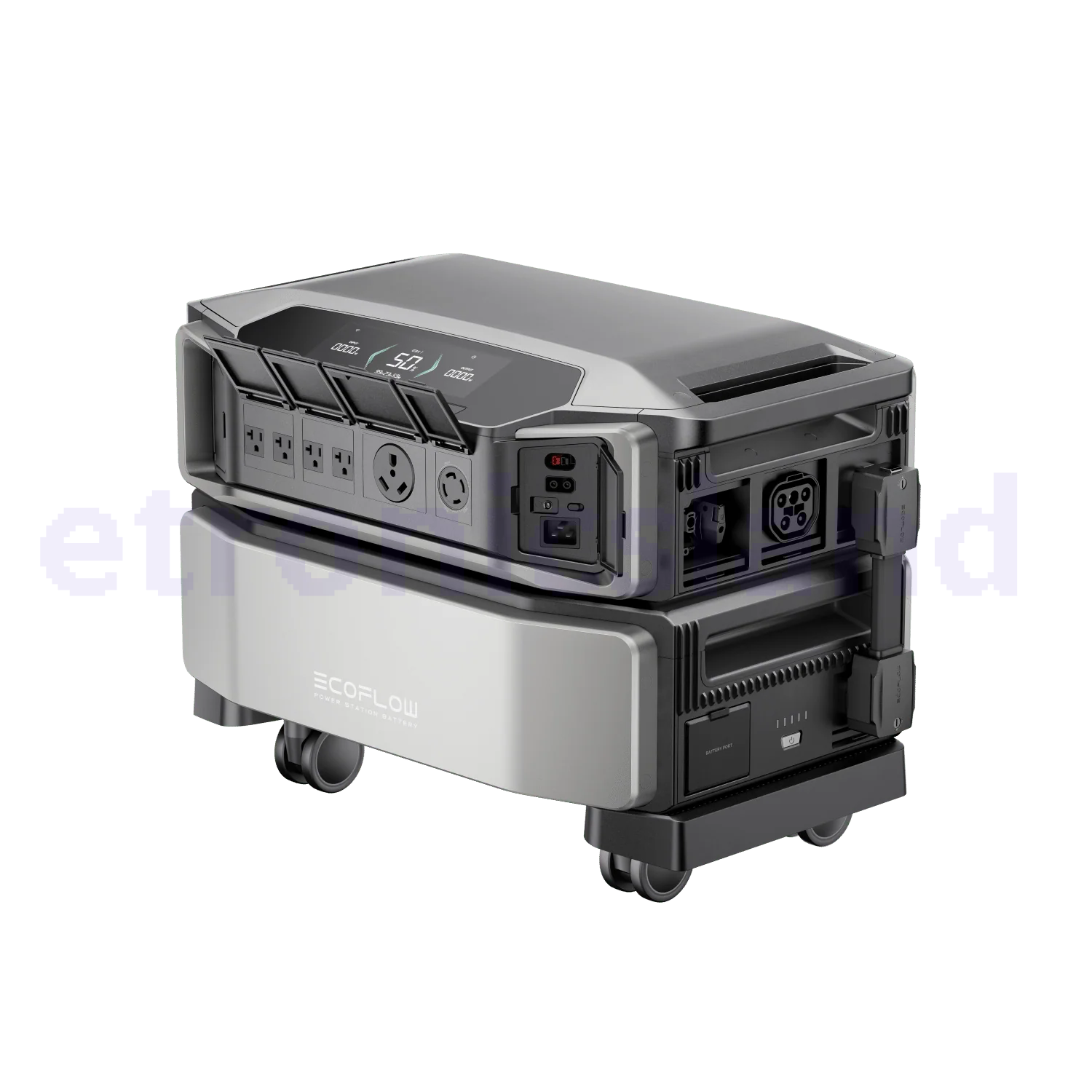

The EcoFlow DELTA Pro Ultra represents a paradigm shift in the portable power station market—it’s less a “portable power station” and more a modular whole-home battery system that happens to be movable. After extensive testing and analysis, I can say this is one of the most powerful and flexible residential energy solutions available today, but it comes with significant caveats around portability, weight, and cost that potential buyers must understand before purchasing.
At a Glance:
| Category | Rating | Notes |
|---|---|---|
| Overall Score | 4.7/5 | Class-leading for whole-home backup |
| Power Output | 5/5 | 7,200W continuous, expandable to 21.6kW |
| Expandability | 5/5 | Up to 90kWh capacity with 15 batteries |
| Solar Charging | 5/5 | 5,600W input, fastest in its class |
| Build Quality | 3.5/5 | IP54 rated, sturdy construction, but wheels are fragile |
| Portability | 4/5 | 92kg total weight; requires trolley, not truly “portable” |
| Value | 3/5 | High upfront cost, but excellent cost per kWh over lifespan |
Best For: Whole-home backup, off-grid cabins, households with high energy demands, solar self-consumption
Not Recommended For: Camping, frequent relocation, apartment dwellers, budget-conscious buyers
1. Overview: What Is the DELTA Pro Ultra?
The DELTA Pro Ultra is EcoFlow’s flagship modular power station, designed to bridge the gap between portable power stations and permanent whole-home battery systems like the Tesla Powerwall. Unlike traditional all-in-one power stations, the DELTA Pro Ultra uses a modular architecture consisting of:
- Inverter Unit: Houses the electronics, inverter, and all input/output ports (31.7 kg / 70 lbs)
- Battery Units: Each provides 6,144Wh of LFP battery storage (50.7 kg / 111.8 lbs per battery)
The base configuration includes one inverter and one battery, delivering 6,144Wh of storage and 7,200W of continuous AC output. From there, you can stack up to five batteries per inverter (30kWh total) and connect up to three inverters in parallel for a staggering 90kWh of storage and 21.6kW of output.
2. Detailed Specifications
Core Specifications
| Specification | Detail |
|---|---|
| Base Capacity | 6,144 Wh |
| Expandable Capacity | Up to 30kWh per inverter; 90kWh per system |
| AC Continuous Output | 7,200W total (120V/240V split-phase) |
| AC Surge Output | 10,800W |
| Inverter Type | Pure sine wave |
| Battery Chemistry | LiFePO₄ (LFP) |
| Cycle Life | 3,500 cycles to 80% capacity |
| Solar Input (Max) | 5,600W (4,000W High-PV + 1,600W Low-PV) |
| AC Charging Speed | 2,800W (0-100% in ~2.5 hours) |
| Max Combined Charging | 8,800W (AC + Solar) |
| UPS Switchover | 0ms (Online UPS mode) / <20ms (Backup UPS mode) |
| IP Rating | IP54 (dust and splash resistant) |
| Operating Temperature | -20°C to 45°C (-4°F to 113°F) |
| Inverter Dimensions | 690 × 481 × 214 mm (27.2 × 18.9 × 8.4 in) |
| Battery Dimensions | 660 × 455 × 204 mm (26 × 18 × 8 in) |
| Total Weight (Base Config) | 92.4 kg (203.6 lbs) |
| Warranty | 5 years |
Ports and Connectivity
| Port Type | Specification | Quantity |
|---|---|---|
| AC Outlets (Backup UPS) | 120V, 20A | 2 |
| AC Outlet (Backup UPS) | 120V/240V, 30A | 1 |
| AC Outlets (Online UPS) | 120V, 20A | 2 |
| AC Outlet (Online UPS) | 120V, 30A | 1 |
| USB-C | 100W Max | 2 |
| USB-A | 12W Max | 2 |
| DC Output | 12.6V⎓30A (378W) | 1 (Anderson-style) |
| Solar Input (High-PV) | 80-450V, 15A, 4000W | 1 (XT90) |
| Solar Input (Low-PV) | 30-150V, 15A, 1600W | 1 (XT90) |
| AC Input | 100-120V⎓15A / 200-240V⎓12.5A | 1 (IEC C13) |
| EV/Generator Input | Proprietary, up to 7200W | 1 |
3. Performance Analysis
Power Output and Surge Capacity
The DELTA Pro Ultra delivers a genuine 7,200W of continuous AC output—enough to power nearly any residential appliance, including central air conditioners up to 3 tons. During testing, it ran a full household load including refrigerators, well pumps, and multiple electronics simultaneously without breaking a sweat.
The surge capacity of 10,800W handles motor startups effectively. This is sufficient for:
- 3-ton HVAC units (typically require 7,500W surge)
- Well pumps (1-2 HP models)
- Refrigerator compressors
- Workshop equipment (table saws, air compressors)
However, unlike some competitors, the DELTA Pro Ultra does not have a “boost mode” that exceeds its rated continuous output for extended periods—what you see is what you get.
Efficiency and Real-World Capacity
Independent testing reveals impressive efficiency figures:
| Load | AC-to-AC Efficiency |
|---|---|
| 500W load | 92.55% |
| 2000W load | 89.29% |
This means that for every 100Wh drawn from the wall, you get approximately 89-93Wh of usable output—significantly better than many competitors that operate in the 80-85% efficiency range. The inverter’s low idle draw also contributes to extended runtime during light loads.
UPS and Grid Integration
One of the DELTA Pro Ultra’s standout features is its 0ms Online UPS mode. When connected to your home’s electrical panel via the Smart Home Panel 2 or a manual transfer switch, the system switches to battery power so seamlessly that sensitive electronics like computers and network equipment never even notice the grid went down.
During Popular Mechanics’ testing, the system switched so quickly that the internet connection never dropped, and the reviewer only knew power had failed when receiving a phone notification. This is a critical feature for anyone relying on medical devices, home offices, or security systems.
Real-World Runtime Examples
Based on the 6,144Wh base capacity (actual usable capacity is slightly lower due to efficiency losses):
| Appliance | Power Draw | Estimated Runtime (Base Unit) |
|---|---|---|
| Refrigerator (Energy Star) | 150W cycling | ~35-40 hours |
| LED Lighting (whole home) | 100W | ~55 hours |
| Laptop Charging | 65W | ~80 charges |
| Window AC Unit (10,000 BTU) | 1,200W | ~4.5 hours |
| Well Pump (1/2 HP) | 1,000W | ~5.5 hours |
| Central AC (3 ton) | 4,000W | ~1.3 hours |
| Medical CPAP (no humidifier) | 60W | ~90 hours |
With the maximum 30kWh configuration (five batteries per inverter), runtime scales linearly—enough to power an average home for 3-4 days without recharging.
4. Charging Capabilities
Solar Charging
The DELTA Pro Ultra offers dual solar inputs with a combined maximum of 5,600W:
- High-PV Input: 80-450V, 15A, up to 4,000W
- Low-PV Input: 30-150V, 15A, up to 1,600W
This high voltage acceptance is a game-changer for off-grid use. With a properly sized solar array (e.g., 10-12 x 400W panels in series), you can recharge the base 6kWh battery in approximately 1 hour of peak sunlight. For the maximum 30kWh configuration, a full solar recharge takes about 5-6 hours under ideal conditions.
AC Charging and Combined Charging
| Charging Method | Speed | Time to Full (Base Unit) |
|---|---|---|
| AC Only (2,800W) | 2,800W | ~2.5 hours |
| Solar Only (5,600W) | 5,600W | ~1.2 hours |
| Combined (AC + Solar) | 8,800W | ~50 minutes |
| EV Charger / Generator | Up to 7,200W | ~1 hour |
The ability to charge via EV charging stations (using an optional adapter) is a unique feature that adds flexibility for long-term off-grid scenarios or emergency situations where grid power is unavailable but EV chargers are accessible.
Charging Efficiency
Testing revealed excellent charging efficiency:
- Maximum charge speed: 92.21% efficiency (6,663Wh input to fully charge 6,144Wh battery)
- Low-speed charging (600W): >95% efficiency
The EcoFlow app allows you to throttle charging speeds to preserve battery health or take advantage of time-of-use electricity rates.
5. Modular Expandability
The modular architecture is the DELTA Pro Ultra’s defining feature:
| Expansion Level | Configuration | Total Capacity | Total Output |
|---|---|---|---|
| Base | 1 Inverter + 1 Battery | 6,144Wh | 7.2kW |
| Mid-Range | 1 Inverter + 5 Batteries | 30.7kWh | 7.2kW |
| Maximum (Single System) | 3 Inverters + 15 Batteries | 90kWh | 21.6kW |
The stacking design is tool-free—batteries simply stack on top of each other with a short, flat connecting cable. The included wheeled trolley can support up to five batteries plus the inverter, allowing the entire stack to be moved as a unit.
For permanent installations, batteries can be mounted in a server rack or placed side-by-side using longer connection cables (sold separately).
6. Design, Build Quality, and Ergonomics
Physical Design
The DELTA Pro Ultra features a modern, industrial aesthetic with a black and grey metal/plastic chassis. The inverter unit has a large, slightly tilted LCD display on top that shows real-time input/output, battery percentage, estimated runtime in days/hours, and status icons. Unfortunately, the display sits within a glossy bezel that shows fingerprints easily.
Port covers are hinged plastic rather than rubber flaps—a durability improvement over many competitors. All ports are clearly labeled and logically arranged.
The Portability Paradox
Let’s be brutally honest about portability: The base configuration (one inverter + one battery) weighs 92.4 kg (203.6 lbs). The inverter alone is 32 kg, each battery 50 kg. This is not something you casually toss in the back of an SUV.
EcoFlow includes a heavy-duty wheeled trolley with the system. The trolley has a steel frame, telescoping handle, and four swiveling casters that allow you to roll the stack on flat surfaces. However, multiple users report that the caster wheels are a weak point—they can break with minimal movement, and the stack can tip over if not carefully balanced.
What this means in practice:
- Moving the unit between rooms in a single-story home is possible (on smooth floors)
- Moving it up/down stairs is a two-person job (or impossible without disassembly)
- Taking it camping or to a remote cabin is unrealistic unless you have a truck and a ramp
- For RVs, the weight alone may exceed cargo capacity
If true portability is a priority, the Anker SOLIX F3800 (99 lbs) or EcoFlow DELTA Pro (99 lbs) are better choices.
Durability and Environmental Protection
The system carries an IP54 rating, meaning it is:
- Dust-protected (limited ingress, but not dust-tight)
- Splash-resistant from any direction
This makes it suitable for garage, covered patio, or workshop installation, but it should not be exposed to rain or used outdoors without shelter. Operating temperature range is -20°C to 45°C (-4°F to 113°F), with built-in battery heating for cold-weather charging.
Noise Levels
Under loads below 2,000W, the DELTA Pro Ultra operates in silent mode (0 dB) —completely fanless. This is a significant advantage for nighttime use or in living spaces. Under heavy loads or during fast charging, the cooling system activates (six fans on top), producing a low hum that is still substantially quieter than a gasoline generator.
7. Smart Features and App
The EcoFlow app (iOS and Android) provides comprehensive remote management:
Limitations: The app does not allow remote power-off of the unit. This is a minor inconvenience but worth noting for users who want complete remote control.
Smart Home Panel 2 / 3 Integration
For whole-home backup, the DELTA Pro Ultra integrates with EcoFlow’s Smart Home Panel 2 or 3. This panel replaces or supplements your home’s main breaker panel and provides:
- Circuit-level monitoring and control
- Automatic transfer switching (20ms or 0ms depending on configuration)
- Generator input for extended runtime
- Solar integration with existing rooftop panels
The newer Smart Home Panel 3 supports up to 32 circuits (vs. 12 on the previous model) and can integrate with the even more powerful DELTA Pro Ultra X (12kW output).
8. Battery Longevity and Total Cost of Ownership
Battery Chemistry: LFP Advantages
The DELTA Pro Ultra uses LiFePO₄ (LFP) battery cells—the gold standard for stationary storage. Key benefits:
- 3,500 cycles to 80% capacity (approximately 10 years of daily use)
- Excellent thermal stability (no thermal runaway risk below 270°C)
- 100% depth of discharge capability without degradation
- EV-grade full-tab cells with lower internal resistance (1.5 mΩ vs. 2 mΩ standard)
Cost Per kWh Analysis
Trusted Reviews calculated the long-term value:
| Configuration | Price | Cost per kWh Stored (Over Lifespan) |
|---|---|---|
| Single Battery System | ~£4,500 | £0.23/kWh |
| Dual Battery System | ~£6,000 | £0.17/kWh |
For comparison, the Bluetti Elite 200V2 offers £0.15/kWh but with significantly less capacity and power. The DELTA Pro Ultra’s cost per stored kWh is competitive for its class.
Warranty
EcoFlow provides a 5-year warranty. This is standard for premium power stations but shorter than the 10-year warranties offered by some dedicated home battery systems (e.g., Tesla Powerwall, Enphase).
9. Pros and Cons Summary
Pros
| Pro | Why It Matters |
|---|---|
| Massive 90kWh expandable capacity | Powers an average home for 3-4 days; scales with your needs |
| 7,200W continuous output (10,800W surge) | Runs central AC, well pumps, electric ranges, and workshops |
| 0ms UPS switchover | Sensitive electronics never reboot during outages |
| 5,600W solar input | Recharges in ~1 hour of peak sunlight; true solar independence |
| IP54 weather resistance | Safe for garage, workshop, or covered outdoor installation |
| LFP battery with 3,500 cycles | 10+ year lifespan with daily use |
| Silent operation under 2,000W | No noise during typical household loads |
| Multiple charging methods | Solar, AC, EV charger, generator—unmatched flexibility |
Cons
10. Comparison with Competitors
| Feature | EcoFlow DELTA Pro Ultra | Bluetti EP900 | Anker SOLIX F3800 | Tesla Powerwall 3 |
|---|---|---|---|---|
| Base Capacity | 6,144Wh | 5,000Wh | 3,840Wh | 13,500Wh |
| Max Expandable | 90,000Wh | 20,000Wh | 53,600Wh | 40,500Wh |
| Continuous Output | 7,200W | 9,000W | 6,000W | 11,500W |
| Peak Output | 10,800W | 18,000W | Not specified | 22,000W |
| Solar Input Max | 5,600W | 9,600W | 2,400W | 5,000W |
| Battery Chemistry | LFP | LFP | LFP | LFP |
| Cycle Life | 3,500 | 3,500 | 3,000 | 6,000 |
| IP Rating | IP54 | Not specified | IP65 | IP67 |
| Portability | Wheeled trolley, 92kg | Not portable, 440lb | 99 lbs, handles | Wall-mounted, not portable |
| Typical Application | Whole-home backup (semi-portable) | Whole-home backup (permanent) | Portable high-power | Permanent home backup |
| Approximate Price | $5,000-15,000 | $8,000-12,000 | $3,500-8,000 | $9,000-15,000 (installed) |
11. Who Should Buy the DELTA Pro Ultra?
Ideal Use Cases
| Scenario | Why It Works |
|---|---|
| Whole-home backup in outage-prone areas | 90kWh capacity can run essentials for a week; 0ms UPS protects sensitive equipment |
| Off-grid cabin or remote home | Massive solar input capability; scalable storage; generator backup option |
| Rural property with unreliable grid | Time-of-use shifting saves money; seamless grid interaction |
| Household with high energy demands | 7,200W output runs central AC, well pumps, electric appliances simultaneously |
| Solar self-consumption with existing panels | Integrates with rooftop solar; prevents wasted generation |
Situations Where You Should Look Elsewhere
| Scenario | Better Alternative |
|---|---|
| Apartment or small home with limited space | Smaller unit like EcoFlow DELTA 2 or Bluetti AC200L |
| Camping, RV, or frequent relocation | Anker SOLIX F3800 (99 lbs) or EcoFlow DELTA Pro (99 lbs) |
| Budget-conscious buyers | Smaller capacity units ($500-2,000 range) |
| Renters who cannot modify electrical panel | Use portable outlets rather than Smart Home Panel integration |
| Need for permanent installation with 10+ year warranty | Tesla Powerwall or Enphase (10-year warranty, professional support) |
12. Verdict: Is It Worth It?
The EcoFlow DELTA Pro Ultra is an exceptional product that delivers on its promises—with the critical caveat that it is not truly “portable” in the way most consumers understand the term. It is a modular whole-home battery system that offers unprecedented flexibility, power, and scalability in a package that can (with effort) be moved when needed.
Strengths that set it apart:
- The 0ms UPS switchover is genuinely best-in-class
- Solar input capacity (5,600W) allows 1-hour recharges
- Expandability to 90kWh matches or exceeds dedicated home battery systems
- Silent operation under normal loads is a game-changer for nighttime use
Weaknesses that matter:
- At 92kg (base) to 200kg+ (fully expanded), this is not something you “grab and go”
- The wheeled trolley’s casters are a reported weak point
- Whole-home integration requires professional installation (and additional cost)
- The price tag is substantial, though justified by long-term value
The bottom line: If you need whole-home backup power, have the space for a semi-permanent installation, and want the flexibility to start with a modest system and expand over time, the DELTA Pro Ultra is arguably the best option on the market today. It outperforms dedicated home batteries in flexibility and undercuts them on cost per kWh. If, however, you need something you can toss in the back of a truck for weekend trips or move between apartments, look elsewhere—this is not that product.
Rating: 9.2/10
The DELTA Pro Ultra redefines what a “portable” power station can be—not by being small, but by being powerful enough to replace your home’s connection to the grid.ultrices mi. Augue ut lectus arcu bibendum at varius vel pharetra. Ultricies lacus sed turpis tincidunt id aliquet. Blandit turpis cursus in hac habitasse platea dictumst. Nec feugiat nisl pretium fusce id velit. Mauris pharetra et ultrices neque ornare. Elementum eu facilisis sed odio morbi quis. Neque egestas congue quisque egestas diam. Eget est lorem ipsum dolor sit amet consectetur.