

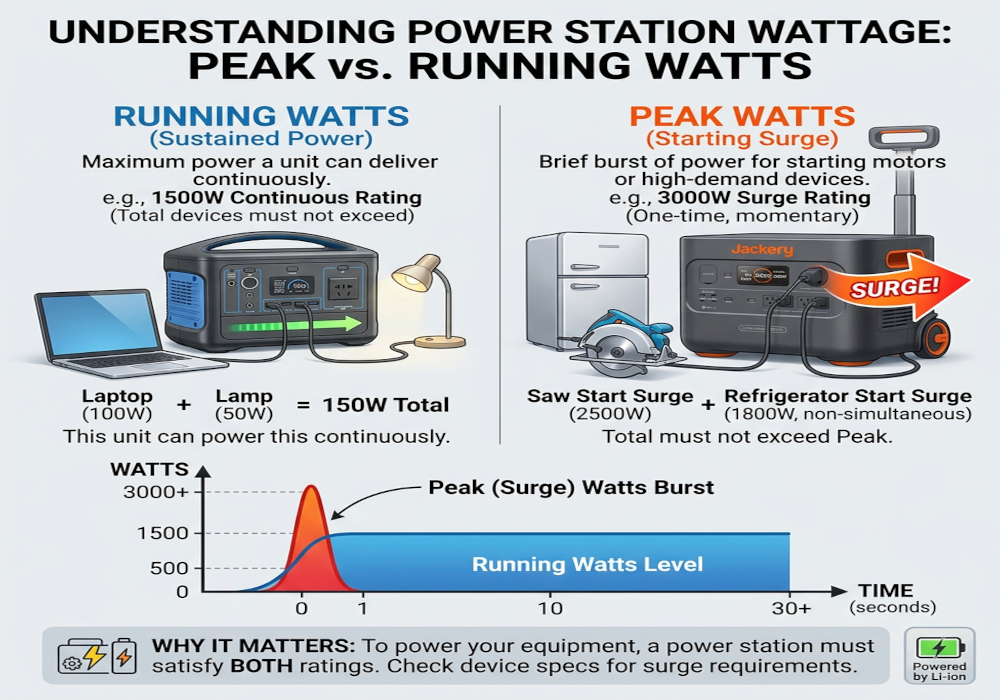
Understanding the distinction between peak watts (surge watts) and running watts (continuous watts) is essential for selecting a portable power station that can reliably power your devices without tripping overload protection. Misinterpreting these specifications is one of the most common reasons users experience shutdowns, failed appliance startups, or premature inverter failure. Below, I provide a comprehensive technical and practical breakdown of these two critical ratings.
1. Definitions and Fundamental Concepts
Running Watts (Continuous Watts)
Running watts—also called rated watts, continuous watts, or nominal watts—is the amount of power a portable power station can deliver sustainably and indefinitely under normal operating conditions. This is the baseline output the inverter is designed to handle for extended periods without overheating, voltage sag, or triggering protective shutdowns.
- Measurement: Expressed in watts (W) or kilowatts (kW)
- Duration: Continuous; the unit can maintain this output until the battery is depleted
- Inverter Rating: The running wattage is typically the primary specification listed in product literature (e.g., “3000W pure sine wave inverter”)
- Example: A unit rated for 3000W running can power a 1500W space heater and a 1200W toaster simultaneously for hours without issue
Peak Watts (Surge Watts)
Peak watts—also called surge watts, startup watts, or momentary watts—is the maximum power the inverter can deliver for a very brief period, typically measured in milliseconds to a few seconds. This extra capacity exists to accommodate the inrush current required by certain appliances when they first start up.
- Measurement: Expressed in watts, often double or more than the running wattage
- Duration: Usually 0.1–5 seconds, though some manufacturers specify longer durations (e.g., 10 seconds) for certain surge ratings
- Purpose: Designed exclusively for motor startup and capacitor charging loads
- Example: A refrigerator may draw 150W running but requires 800–1200W surge for 1–2 seconds when the compressor kicks on
2. Why the Distinction Matters
The Physics of Inrush Current
Many appliances contain electric motors, compressors, or transformers that require significantly more current to start than to run. This phenomenon, called inrush current, occurs because:
- Motors: At startup, the motor is stationary and presents minimal impedance (counter-electromotive force hasn’t developed), causing a momentary current spike 3–8 times the running current
- Capacitors: Devices with large capacitors (e.g., amplifiers, power supplies) draw a surge to charge the capacitors
- Transformers: Inductive loads create a magnetic field surge during initial energization
If the power station cannot supply this momentary surge, one of three outcomes occurs:
| Outcome | Description |
|---|---|
| Overload Shutdown | The inverter’s protection circuit triggers, cutting power to all outlets |
| Voltage Sag | The inverter struggles to maintain voltage, causing lights to dim, motors to stall, or electronics to malfunction |
| Component Stress | Repeated surge failures can degrade inverter components over time |
Real-World Example: Refrigerator
Consider a standard 18-cubic-foot refrigerator:
| Parameter | Power Requirement |
|---|---|
| Running Watts | 150–200W |
| Surge Watts (compressor startup) | 800–1,200W |
| Duration of Surge | 1–2 seconds |
A power station rated for 1000W running but 2000W peak will start this refrigerator without issue. However, a unit rated for 1000W running with no peak capacity above that will likely trip its overload protection every time the compressor cycles on.
3. How Manufacturers Specify Peak and Running Watts
Manufacturers present these specifications inconsistently, creating confusion for consumers. Understanding the terminology is critical.
Common Labeling Variations
| Manufacturer Terminology | What It Typically Means |
|---|---|
| “3000W Pure Sine Wave Inverter” | Usually refers to running watts; peak may be specified separately |
| “3000W Surge / 1500W Continuous” | Peak capacity listed first; running capacity second |
| “Max. Output 3000W” | Ambiguous—may refer to peak or running; requires reading footnotes |
| “3000W Rated / 6000W Peak” | Clear distinction; 3000W continuous, 6000W momentary surge |
Important Discrepancies to Watch For
Overstated Peak Ratings: Some manufacturers advertise surge capacities that are technically achievable but only under ideal conditions (cold inverter, fully charged battery, no other loads). In real-world use, sustained peak performance may be lower. Independent testing often reveals that a unit advertised with 2x surge capability may only deliver 1.5x reliably.
Unspecified Surge Duration: A peak rating of 6000W for 20 milliseconds is functionally useless for starting a refrigerator, which requires 1–2 seconds of surge. Reputable manufacturers specify the duration (e.g., “6000W surge for 10 seconds”).
Temperature-Dependent Derating: In hot environments (35°C+), inverters may derate—automatically reducing both running and surge capacities to prevent overheating. A unit rated for 3000W continuous may throttle to 2400W after 30 minutes in tropical conditions.
4. Power Demands by Appliance Type
Understanding the surge characteristics of different appliance categories helps match a power station to your specific needs.
Resistive Loads (No Surge)
Resistive loads convert electricity directly into heat or light. They draw the same power at startup as during operation, making them ideal for power stations with limited surge capacity.
| Appliance | Typical Running Watts | Surge Factor | Notes |
|---|---|---|---|
| Incandescent Bulb | 60–100W | 1x | No surge |
| Space Heater | 1,000–1,500W | 1x | Pure resistive load |
| Electric Kettle | 1,200–1,500W | 1x | No startup spike |
| Coffee Maker | 800–1,200W | 1x | Heating element only |
| Toaster | 800–1,500W | 1x | No surge |
| Hair Dryer | 1,200–1,800W | 1x | Resistive with small motor |
Inductive Loads (High Surge)
Inductive loads contain motors, compressors, or transformers. They require significant surge current for startup, typically 3–8 times running watts, lasting 0.5–3 seconds.
| Appliance | Typical Running Watts | Typical Surge Watts | Surge Duration |
|---|---|---|---|
| Refrigerator (compressor) | 150–250W | 800–1,500W | 1–2 seconds |
| Freezer | 150–300W | 1,000–2,000W | 1–2 seconds |
| Sump Pump (1/2 HP) | 800–1,000W | 2,000–3,000W | 1–3 seconds |
| Well Pump (1 HP) | 1,500–2,000W | 4,000–6,000W | 2–3 seconds |
| Air Compressor | 1,000–1,500W | 3,000–5,000W | 1–2 seconds |
| Table Saw | 1,200–1,800W | 3,000–4,500W | 1–2 seconds |
| Window AC (10,000 BTU) | 800–1,200W | 2,000–3,500W | 2–3 seconds |
Capacitive Loads (Brief Surge)
Capacitive loads have large internal capacitors that charge instantly upon connection, creating a very brief but intense surge.
| Appliance | Typical Running Watts | Typical Surge Watts | Surge Duration |
|---|---|---|---|
| Desktop Computer | 200–600W | 300–800W | <0.1 seconds |
| Amplifier | 100–500W | 200–1,000W | <0.1 seconds |
| Switching Power Supply | Varies | 2–5x running | <0.2 seconds |
Electronics and Sensitive Devices
Modern electronics with switching power supplies often have minimal surge but require pure sine wave output to operate correctly. Modified sine wave inverters can cause malfunction, overheating, or damage.
5. How to Calculate Your Peak and Running Requirements
Step 1: List All Devices to Be Powered Simultaneously
Create an inventory of every device you intend to run at the same time. For each, record:
- Running watts (from the device label or manufacturer specifications)
- Surge watts (often not listed; use typical values from the tables above)
Step 2: Calculate Total Running Watts
Sum the running watts of all devices that will operate simultaneously.
text
Total Running Watts = Σ (Device Running Watts)
Step 3: Identify the Single Largest Surge
The critical calculation is not the sum of all surge watts, but rather the largest single surge added to the sum of all other running loads. This is because surges occur sequentially in most real-world scenarios—refrigerator compressors cycle on and off independently, and you don’t typically start multiple motors simultaneously.
text
Required Peak Capacity = (Total Running Watts - Device with Surge) + (Largest Single Surge)
Worked Example
You want to power:
- Refrigerator: 200W running / 1,200W surge
- LED TV: 100W running / negligible surge
- Laptop: 65W running / negligible surge
- 4 LED Lights: 40W running total / no surge
Step 1: Total running watts = 200 + 100 + 65 + 40 = 405W
Step 2: Largest surge = refrigerator = 1,200W
Step 3: Required peak capacity = (405 – 200) + 1,200 = 1,405W
Result: A power station with at least 405W running and 1,405W peak will handle this configuration.
6. Inverter Types and Their Impact on Peak Performance
Pure Sine Wave Inverters
All premium portable power stations use pure sine wave inverters. These produce AC power that matches or exceeds grid power quality, with total harmonic distortion (THD) below 3%. They handle surge loads most effectively because:
- The waveform allows motors to start with less current draw than modified sine wave
- Voltage regulation remains stable during surge events
- Sensitive electronics operate without risk of damage
Modified Sine Wave Inverters
Found only in budget or entry-level units, modified sine wave inverters produce a stepped approximation of a sine wave. They have significant limitations:
- Reduced Surge Capacity: Motors may require 30–50% higher startup current, often exceeding the inverter’s capability
- Inefficient Motor Operation: Motors run hotter, noisier, and with reduced torque
- Incompatibility: Many electronics, medical devices, and variable-speed tools will not function
Pure Sine Wave vs. Modified Sine Wave Comparison
| Characteristic | Pure Sine Wave | Modified Sine Wave |
|---|---|---|
| Waveform | Smooth sinusoidal | Stepped square wave |
| THD (Total Harmonic Distortion) | <3% | 25–40% |
| Motor Starting Ability | Excellent; delivers rated surge | Poor; surge capacity often overstated |
| Appliance Compatibility | All devices | Resistive loads only; motors and electronics may fail |
| Efficiency | 85–95% | 75–85% |
| Typical Applications | Premium portable stations | Budget units, car inverters |
7. Battery Chemistry’s Role in Peak Performance
The ability to deliver surge power depends not only on the inverter but also on the battery’s discharge rate, measured in C-rating.
C-Rating Explained
The C-rating indicates how quickly a battery can safely discharge its capacity. A 1C rating means the battery can deliver its full capacity in one hour. For surge events, the battery must deliver high current instantaneously.
| Battery Chemistry | Typical Peak Discharge Rate | Implication for Surge |
|---|---|---|
| LiFePO₄ (LFP) | 2C–5C continuous; 5C–10C peak | Excellent surge capability; high current delivery without voltage sag |
| NMC (Lithium-Ion) | 3C–8C continuous; 8C–15C peak | Very high surge potential; lighter cells can deliver intense bursts |
| Standard Lithium | 1C–2C continuous; 2C–3C peak | Limited surge; voltage sag under heavy startup loads |
Practical Example
A 3,000Wh LiFePO₄ battery with a 5C peak rating can deliver 15,000W instantaneously—far more than any inverter in its class requires. Battery chemistry rarely limits surge performance in quality units; the inverter is almost always the bottleneck.
8. Overload Protection Mechanisms
Understanding how your power station responds to overload conditions helps avoid unexpected shutdowns.
| Protection Type | Trigger Condition | Response |
|---|---|---|
| Inverter Overload | Peak watts exceeded for >0.5–5 seconds | All AC outlets shut down; error code displayed; requires manual reset |
| Thermal Overload | Inverter temperature exceeds safe threshold (typically 65–85°C) | Gradual power reduction (derating) or full shutdown until cooling |
| Battery Overcurrent | Battery discharge rate exceeds BMS limit | DC outputs may drop first; AC may shut down independently |
| Short Circuit | Direct short detected | Immediate instantaneous shutdown; often requires physical reset |
Resetting After Overload
Most portable power stations require:
- Removing the overload condition (unplug the appliance that caused the surge)
- Pressing a reset button or cycling the AC output switch
- In some cases, power cycling the entire unit
9. Common Misconceptions and Pitfalls
Misconception 1: “Peak watts apply to all outlets simultaneously”
Reality: Peak watt ratings apply to the inverter’s total output across all AC outlets combined. If a unit is rated for 3000W running and 6000W peak, that 6000W is the total available across all AC ports. Spreading loads across multiple outlets does not increase total available power.
Misconception 2: “Running watts don’t matter if the surge rating is high”
Reality: A unit with a high peak rating but insufficient running capacity will overheat or degrade quickly under sustained loads. The running wattage must match your continuous power requirements regardless of surge capability.
Misconception 3: “Peak rating is the most important specification for motor loads”
Reality: Surge duration matters as much as peak magnitude. A unit that can deliver 4000W for 20ms may still fail to start a sump pump requiring 3000W for 2 seconds. Always verify surge duration specifications.
Misconception 4: “You can sum all surge watts to determine requirements”
Reality: As explained above, surges occur sequentially, not simultaneously, in most real-world scenarios. Summing all surge watts leads to overspecification and unnecessary cost.
10. Summary Comparison Table
| Parameter | Running Watts (Continuous) | Peak Watts (Surge) |
|---|---|---|
| Definition | Sustainable power output indefinitely | Maximum momentary output for milliseconds to seconds |
| Duration | Continuous until battery depletion | 0.1–10 seconds typically |
| Determining Factor | Inverter thermal capacity, cooling system | Inverter transistor limits, battery discharge rate |
| Application | Operating all devices during normal use | Starting motors, compressors, capacitive loads |
| Specification Importance | Primary; must exceed total running load | Secondary; must exceed largest single surge plus other running loads |
| Overload Result | Thermal shutdown after minutes to hours | Instantaneous trip; requires manual reset |
| Common Ratio to Running | 1x | 1.5x–2.5x typical; 3x–4x for premium units |
11. Practical Recommendations
| Use Case | Recommended Running Watts | Recommended Peak to Running Ratio |
|---|---|---|
| Electronics, lighting, small appliances only | Equal to or greater than total running load | 1.2–1.5x (minimal surge needed) |
| Refrigerator/freezer plus electronics | 200–300W above refrigerator running | 2x running; ensure surge exceeds refrigerator startup |
| Sump pump or well pump | 1.5–2x pump running watts | 3–4x running; verify surge duration matches pump requirement |
| Power tools (saws, compressors) | 1.5x highest tool running | 3–4x running; consider inrush characteristics of specific tool |
| Window AC unit | 1.2–1.5x AC running | 2.5–3.5x running; high surge for compressor startup |
| Whole-home backup (multiple motors) | Sum of all expected simultaneous loads | 2–3x running; account for refrigerator, furnace blower, and well pump overlapping |
Final Expert Assessment
Peak and running watts are not merely specifications to compare between models—they are operational boundaries that determine whether your power station will perform reliably under real-world conditions. Running watts define the envelope of continuous operation; exceeding them leads to thermal stress, component degradation, and eventual shutdown. Peak watts define the unit’s ability to handle the momentary demands of motor-driven appliances; insufficient peak capacity renders a power station incapable of powering essential equipment like refrigerators, pumps, and air conditioners.
When evaluating a portable power station, I recommend this sequence:
- Calculate your total running load for all devices you intend to power simultaneously
- Identify the single largest surge requirement among your devices
- Select a unit with running watts at least 20% above your total running load (to provide headroom)
- Verify peak watts exceed (total running load minus the surging device) plus the largest surge
- Confirm surge duration is specified and adequate for your motor loads (2+ seconds for compressors, 3+ seconds for pumps)
A power station that passes these tests will reliably serve your needs without frustrating overload shutdowns or premature inverter failure. Those that do not—regardless of brand reputation or battery capacity—will inevitably disappoint when you need them most.