

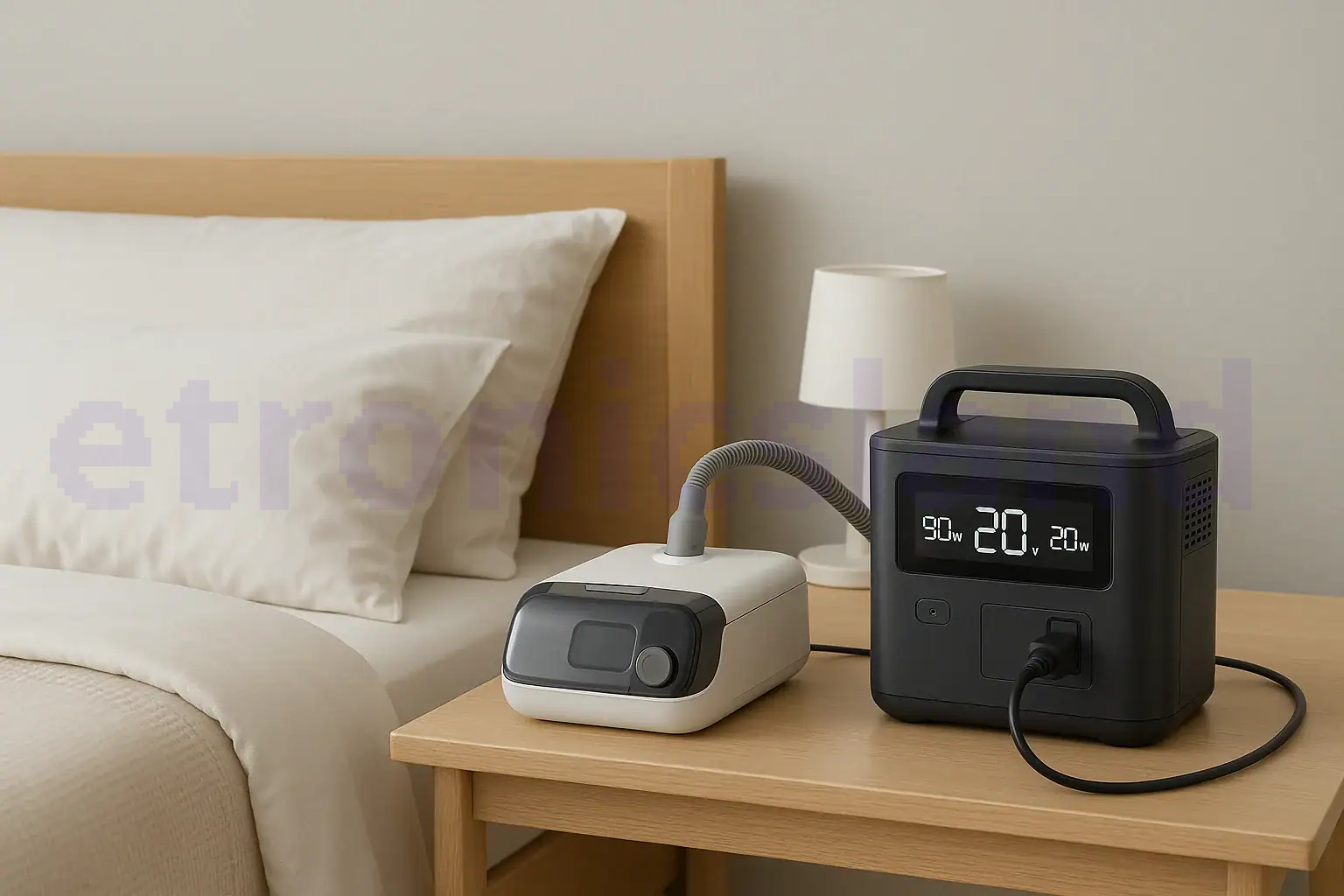
When choosing a portable power station for CPAP and other medical devices, the focus must shift from general convenience to absolute reliability, safety, and therapeutic continuity. You are not just powering a gadget; you are ensuring uninterrupted treatment that is vital for your health. The selection process involves understanding your specific power needs, prioritizing critical technical features, and adopting strategies to maximize runtime and safety.
✅ Essential Checklist for Medical Device Backup Power
Before purchasing, use this checklist to evaluate any portable power station:
- Pure Sine Wave Output: This is non-negotiable. It produces clean, stable power identical to your wall outlet, protecting sensitive medical electronics from damage or malfunction .
- Fast UPS Transfer: Look for a switchover time of ≤10-15ms. This ensures your CPAP or other device doesn’t restart during a brief power flicker .
- LiFePO₄ Battery Chemistry: This is the safest and longest-lasting option (3,000-6,000+ cycles), ideal for daily use and indoor placement. It offers a 10-15 year lifespan .
- DC Output for CPAP: A regulated 12V/24V carport outlet is crucial. Powering your CPAP with a DC-DC converter bypasses the inverter, boosting efficiency by up to 29% and often enabling quieter operation .
- Adequate Capacity (Wh): Use the formula in the next section to calculate your needs. For a single night, a unit with 300Wh-500Wh is a good starting point without a humidifier .
🔢 How to Calculate Your True Power Requirements
The first step is to ignore the “Max Wattage” sticker on your device and determine its actual power consumption.
- Find Your Device’s Wattage: A standard CPAP machine typically draws between 30W and 90W . This number can spike if you use a heated humidifier or heated tube, potentially doubling or tripling the power draw . Check your device’s manual or the label on its power supply brick for its input rating.
- Calculate Needed Capacity: Use this formula for a conservative estimate:
Runtime (hours) ≈ (Battery Capacity in Wh × 0.85) ÷ (Device Wattage)
We use a 0.85 efficiency factor to account for energy loss during the DC-to-AC conversion if you use the standard wall plug . - Example: For a CPAP drawing 60W that you need to run for 8 hours: (Battery Wh × 0.85) / 60W = 8 hours. Solving for battery capacity: (8 × 60) / 0.85 ≈ 565 Wh. This means a 600Wh power station would provide a comfortable margin.
⚡ The Critical Difference: AC vs. DC Power
The single biggest decision you can make to extend your runtime is how you connect your CPAP.
- The Standard AC Method (Less Efficient): Using the CPAP’s original wall plug converts the station’s DC battery power to AC (inverter), which your CPAP then converts back to DC. This dual-conversion process wastes energy, typically making the system only 85-92% efficient .
- The Efficient DC Method (Highly Recommended): By using an official 12V or 24V DC-DC converter cable (designed for your specific CPAP model) plugged into the station’s carport, you eliminate the inverter step. This can boost efficiency to around 95%, often adding hours of runtime and allowing the station to run cooler and quieter .
🧮 Runtime Comparison Table
Here is an estimated runtime guide for a 1,000Wh portable power station, based on different usage scenarios.
| CPAP Configuration | Power Draw (Est.) | Runtime via AC Outlet | Runtime via DC Carport |
|---|---|---|---|
| No Humidifier, No Heated Tube | 30W – 60W | ~14 – 28 hours | ~16 – 32 hours |
| With Humidifier (No Heated Tube) | 60W – 90W | ~9 – 14 hours | ~10 – 16 hours |
| With Humidifier & Heated Tube | 90W – 150W | ~5 – 9 hours | ~6 – 11 hours |
*Note: A real-world extreme case with high heat settings was measured to draw over 1,170Wh in 8 hours, quickly depleting a smaller battery . This underscores the importance of managing your comfort settings during an outage.*
🩺 Beyond the CPAP: Powering Other Medical Devices
Your power needs will change significantly if you have other medical equipment.
⚙️ Expert Tips to Maximize Your Runtime
- Manage Your CPAP Settings: The single most impactful thing you can do is to turn off the heated humidifier and heated tube when running on battery power. This can double or triple your runtime . Consider using a passive humidifier (like a “HME”) if needed.
- Use a DC Adapter: As detailed above, this is the most effective way to gain efficiency and quiet operation.
- Keep It Cool: Place the power station in a well-ventilated area. If it overheats, its internal fans will run loudly, and it may eventually shut down to protect itself .
- Test Your Setup: Before you rely on it during an emergency, do a test run at home. Run your CPAP (with your typical settings) on the power station for a full night to verify the actual runtime and noise level .
In conclusion, the ideal portable power station for medical devices is one that pairs a safe, long-life LiFePO₄ battery with a pure sine wave inverter and a sub-15ms UPS function. Prioritizing a DC output for your CPAP and carefully calculating your total power needs based on your specific device configuration will ensure you select a system that provides reliable, uninterrupted peace of mind.