
The Pecron E3600LFP positions itself as a budget-friendly powerhouse in the portable power station market, offering substantial capacity and output for a fraction of the cost of name-brand competitors like EcoFlow and Bluetti. After analyzing extensive test data and user experiences, here is my detailed, honest review.
Overview & First Impressions
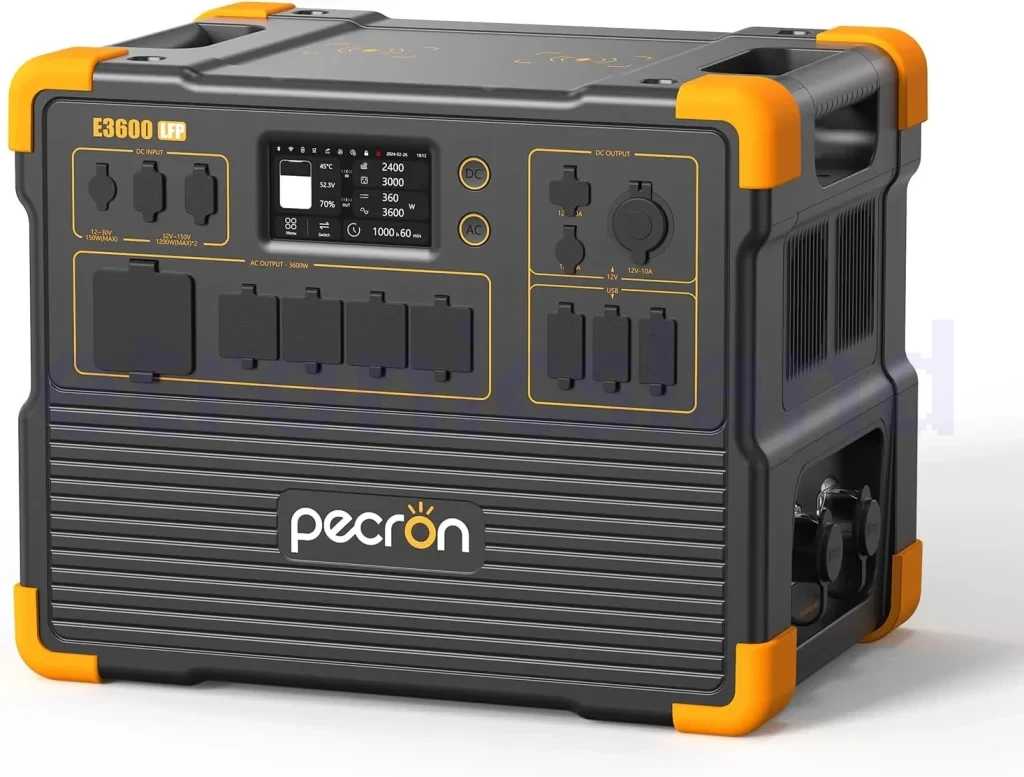
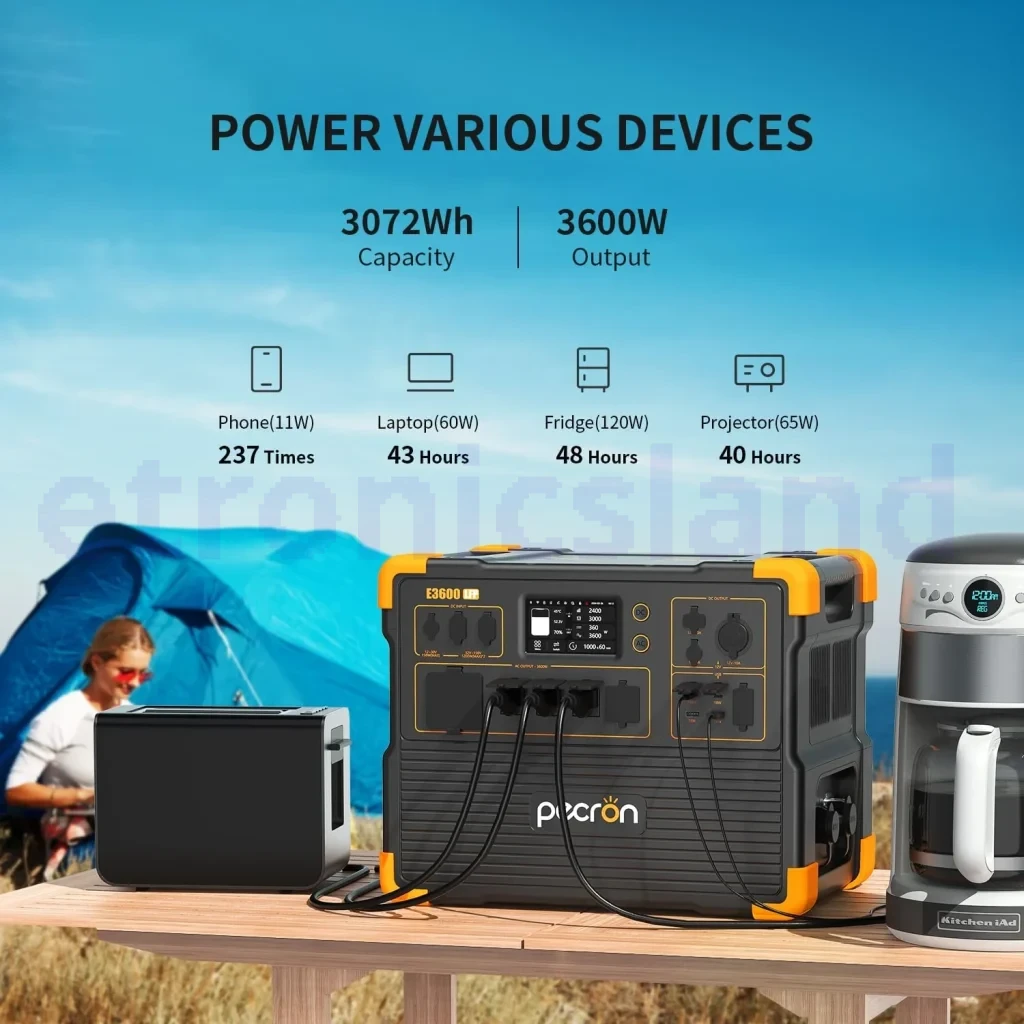
The Pecron E3600LFP is a 3,072Wh LiFePO₄ portable power station with a 3,600W pure sine wave inverter (rated surge up to 7,000W). It’s designed for serious off-grid living, RV use, home backup, and job sites.
- E3600LFP power station (36kg / 79lbs)
- 30A fast charger cable
- 15A standard charger cable
- Car charger (DC5521)
- MC4 to XT60 solar cables (standard + splitter)
- Screwdriver, manual, warranty card, accessory bag
Design & Build Quality
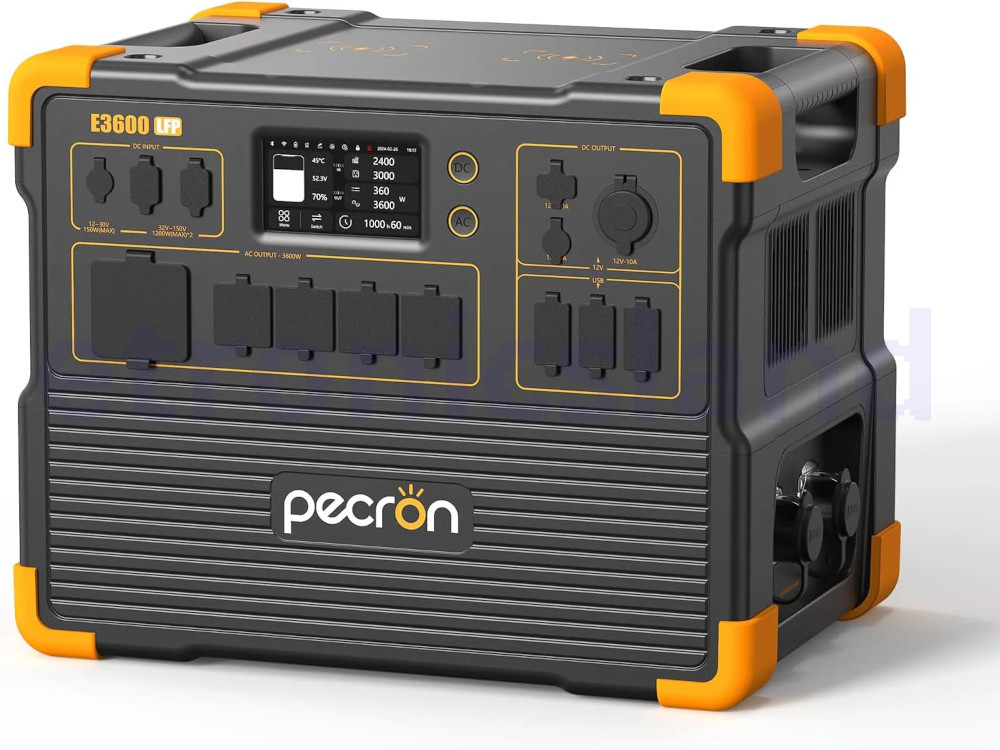
The E3600LFP is not a beauty contest winner. It’s bulky, plain, and utilitarian—”almost like it was designed by a power tool company”. The ABS plastic casing carries a 94V-0 fire rating, and rubber bump stops provide impact protection.
| Feature | Detail |
|---|---|
| Dimensions | 445 × 307 × 350 mm (17.5 × 12.1 × 13.8 in) |
| Weight | 36 kg (79 lbs) |
| Handles | Two built-in handles (requires two people comfortably) |
| Display | 5″ color touchscreen IPS LCD |
| Wireless charging | 2 × 15W pads (top of unit) |
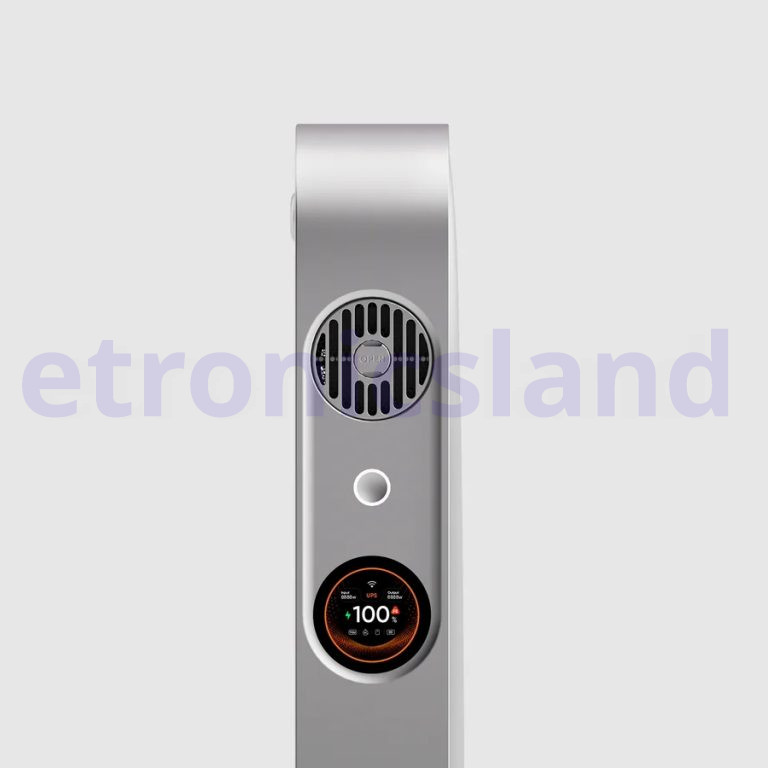
The touchscreen display is a standout feature. Unlike competitors that force you into an app for advanced settings, Pecron puts everything on-device—customizable, with multiple language options and a simplified mode for less tech-savvy users.
Aesthetic Rating: 2/5 — Functional but frumpy.
Ports & Connectivity
One of the E3600LFP’s strengths is its output versatility.
AC Outputs (US version)
| Port Type | Quantity |
|---|---|
| Standard 120V outlets | 4 |
| TT-30 RV outlet (true 30A) | 1 |
*Note: 240V split-phase requires two E3600LFP units + 240V hub (sold separately)*
DC Outputs
| Port Type | Quantity | Specs |
|---|---|---|
| USB-A | 4 | 18W max each |
| USB-C | 2 | 100W + 18W |
| Cigarette lighter (12V) | 1 | 10A |
| DC5525 (12V) | 1 | 5A |
| XT60 (12V) | 1 | 30A |
| Wireless chargers | 2 | 15W each |
Input Ports
| Type | Max Power | Details |
|---|---|---|
| AC (30A cable) | 3,200W | 1.3 hour charge |
| AC (15A cable) | 1,800W | 2 hour charge |
| Solar (XT60-M) | 2,400W (2×1,200W) | Voc 32-150V, 20A max |
| Solar (DC5521) | 150W | Voc 12-30V |
| Car input | 150W | 12-30Vdc |
Ports Rating: 4.5/5 — The true 30A TT-30 outlet is rare at this price point and genuinely useful for RVs.
Performance Testing Results
Efficiency Test
A critical metric: how much of that 3,072Wh battery can you actually use?
Independent testing by The Solar Lab ran the E3600LFP at a 3,300W load (just under max continuous):
| Metric | Result |
|---|---|
| Load | 3,300W continuous |
| Runtime achieved | ~50 minutes |
| Theoretical runtime (100% efficiency) | 55.8 minutes |
| Real-world efficiency | ~89% |
Analysis: 89% efficiency is excellent. Most power stations in this class fall between 80-85%. Pecron beats many name-brand units here.
Efficiency Rating: 4.5/5
Surge Capacity Test (Critical Finding)
Pecron claims 7,000W surge capacity. Testing reveals this is significantly exaggerated.
| Load Test | Result |
|---|---|
| ~4,300W | Ran for ~1 minute before shutdown |
| ~4,500W | Immediate shutdown |
| 7,000W (claimed) | Not achievable |
What this means in practice: The E3600LFP has some surge headroom—enough to handle motor startups on refrigerators, pumps, and air compressors with soft starters. But it will not handle the 7,000W peaks claimed. A more honest surge rating would be ~4,500W for brief periods.
Surge Rating Accuracy: 2/5 (misleading marketing)
Practical Surge Capability: 3.5/5 (still adequate for most needs)
AC Charging Speed Test
| Charging Method | Claimed | Tested | Verdict |
|---|---|---|---|
| 30A cable (3,200W) | 1.3 hours | 1.3 hours | ✅ Accurate |
| 15A cable (1,800W) | 2 hours | ~2.1 hours | ✅ Acceptable |
The 30A charging is genuinely impressive. Most competitors in this class take 2.5-3 hours for a full charge.
⚠️ Important quirk discovered in testing: The E3600LFP continues drawing standby power even after reaching 100% charge. It has no master power switch—the inverter runs continuously. If left plugged in, it will waste electricity. Unplug when fully charged.
Charging Speed Rating: 4.5/5
Idle Power Draw Issue: 2/5
Solar Charging Performance
| Specification | Value |
|---|---|
| Max solar input | 2,400W (2×1,200W strands) |
| Voltage range (XT60-M) | 32-150V Voc |
| Max current | 20A per input |
Testing confirms the E3600LFP can actually hit the 2,400W solar input—impressive and rare in this price bracket.
However, there’s a splitter cable issue: The included MC4 to 2×XT60 splitter cable confused the unit during testing. The station seemed to think it was receiving duplicate input and only accepted one strand. Workaround: Use two separate cables rather than the splitter.
Solar Charging Rating: 4/5 (minus points for splitter confusion)
Noise Level Test
The E3600LFP is loud under load.
| Condition | Noise Description |
|---|---|
| Idle / low load | Acceptable |
| Moderate load (1,000W+) | Noticeable fan whoosh |
| High load (2,500W+) | “Sounds like a 1990s desktop computer” – distracting buzzing + fan noise |
Independent comparison testing notes the Anker F3800 Plus is “noticeably quieter”.
Noise Rating: 2.5/5 — Fine for garages, job sites, or outdoors. Not ideal for bedroom or quiet RV use.
UPS (Uninterruptible Power Supply) Test
| Specification | Value |
|---|---|
| Switchover time | 8-20ms |
| Passthrough power (30A cable) | Full 3,600W |
| Passthrough power (15A cable) | 1,800W |
The UPS function works as advertised. The 20ms switchover is fast enough that most electronics won’t blink. Crucially, with the 30A charger connected, the E3600LFP can maintain nearly full 3,600W output while charging—a significant advantage over competitors whose passthrough is often capped lower.
UPS Rating: 4/5
Expandability (Key Feature)
The E3600LFP supports up to four EP3000-48V expansion batteries.
| Configuration | Total Capacity |
|---|---|
| Base unit only | 3,072Wh |
| +1 EP3000 | 6,144Wh |
| +2 EP3000 | 9,216Wh |
| +3 EP3000 | 12,288Wh |
| +4 EP3000 | 15,360Wh |
Cost comparison for expansion:
- Pecron EP3000 expansion battery: ~$900
- Achieving ~15kWh with Pecron: ~$10,000 total
- Equivalent EcoFlow Delta Pro Ultra setup (18kWh): ~$11,000 for less capacity
Expandability Rating: 5/5 — Best-in-class value for scaling up.
Battery & Longevity
| Specification | Detail |
|---|---|
| Chemistry | LiFePO4 (Lithium Iron Phosphate) |
| Cycle life | 3,500+ cycles to 80% capacity |
| Charge temperature | 0°C to 45°C (32-113°F) |
| Discharge temperature | -20°C to 45°C (-4-113°F) |
The 3,500-cycle rating translates to roughly 10 years of daily use before hitting 80% capacity. This is standard for quality LiFePO4 and excellent for long-term value.
Battery Rating: 4.5/5
App & Smart Features
The E3600LFP includes Wi-Fi and Bluetooth connectivity with a mobile app.
| Feature | Available |
|---|---|
| Real-time monitoring | ✅ |
| Remote output control | ✅ |
| Charge current adjustment | ✅ |
| UPS mode configuration | ✅ |
| Firmware updates | ✅ |
The app is functional if not flashy. Unlike some competitors (Bluetti has app connectivity complaints), Pecron’s app is stable and straightforward. However, the touchscreen display is so good you may rarely use the app.
App Rating: 4/5
Price & Value Analysis
| Pricing Context | Amount |
|---|---|
| MSRP | ~$2,299 |
| Typical street price | $1,259-1,599 |
| Wheeled trolley (optional) | $149 |
At $1,259-1,599 for a 3,072Wh / 3,600W LiFePO4 station, the value proposition is exceptional.
Comparison to competitors (prices approximate):
| Model | Capacity | Power | Typical Price | Value Index |
|---|---|---|---|---|
| Pecron E3600LFP | 3,072Wh | 3,600W | $1,259 | ⭐⭐⭐⭐⭐ |
| EcoFlow Delta Pro | 3,600Wh | 3,600W | $2,700+ | ⭐⭐⭐ |
| Bluetti AC300 + B300 | 3,072Wh | 3,000W | $2,500+ | ⭐⭐ |
| Anker F3800 Plus | 3,840Wh | 6,000W | $2,850 | ⭐⭐⭐⭐ |
The E3600LFP delivers approximately double the value per dollar compared to EcoFlow and Bluetti.
Value Rating: 5/5
User Experience Summary (Compiled from Reviews)
Positive User Feedback
“The three battery extension packs easily power our entire RV system, including the AC unit (with soft start).” — Verified owner, July 2025
“They got us through a bad hurricane safely. The 5 AC outlets allow me to use more devices. I have used them every day for several months and have never had any problems.” — Verified owner, August 2024
“The 30A RV outlet allows it to function flawlessly as a solar generator, keeping everything operational even on overcast days.” — Verified owner, June 2025
Negative User Feedback & Complaints
- Customer service issues: Multiple reports of slow responses, warranty claim difficulties, and shipping problems
- Quality control: Reports of DOA units (outlets not working), fan problems requiring replacement
- Shipping delays: Several users reported weeks-long waits with poor communication
- Battery capacity discrepancy: One user claimed actual capacity was ~30% below advertised (though this is isolated)
Customer Service Rating: 2/5 (consistent pattern of complaints)
Comparison Chart: Pecron E3600LFP vs Top Competitors
| Specification | Pecron E3600LFP | EcoFlow Delta Pro | Bluetti AC300 + B300 | Anker F3800 Plus |
|---|---|---|---|---|
| Battery capacity | 3,072Wh | 3,600Wh | 3,072Wh | 3,840Wh |
| Rated power | 3,600W | 3,600W | 3,000W | 6,000W |
| Peak power | 7,000W (overstated) | 7,200W | 6,000W | 12,000W |
| AC charge time | 1.3h (30A) | 2.7h | 2-2.5h | 1.8h (standard) |
| Max solar input | 2,400W | 1,600W | 2,400W | 3,200W |
| Max expandable | 15,360Wh | 25,000Wh | 12,288Wh | 26,880Wh |
| Weight | 36kg (79lbs) | 45kg (99lbs) | ~50kg (combined) | ~50kg |
| TT-30 RV outlet | ✅ True 30A | ❌ | ❌ | ❌ (25A usable) |
| Touchscreen display | ✅ 5″ color | ❌ Basic | ❌ Basic | ❌ Basic |
| Wireless charging | ✅ 2×15W | ❌ | ❌ | ❌ |
| Typical price | $1,259-1,599 | $2,700+ | $2,500+ | $2,850 |
| Value rating | Excellent | Poor | Poor | Good |
Pros & Cons Summary
Pros ✅
| Category | Detail |
|---|---|
| Price | Unbeatable value for 3kWh/3.6kW class |
| Charging speed | 1.3h AC charging is class-leading |
| Solar input | 2,400W max – actually achievable |
| TT-30 outlet | True 30A RV plug, rare at this price |
| Expandability | Up to 15.4kWh, expansion batteries are affordable |
| Touchscreen | Full on-device control, no app required |
| Efficiency | ~89% real-world efficiency |
| UPS passthrough | Full 3,600W while charging with 30A cable |
| Ports | Excellent variety including 100W USB-C |
Cons ❌
| Category | Detail |
|---|---|
| Surge claim | 7,000W rating is false – realistically ~4,500W |
| Noise level | Loud under high load, distracting buzzing |
| Weight | 79lbs, awkward to carry without wheel kit |
| No power switch | Always-on inverter wastes standby power |
| Splitter cable | Included solar splitter may not work correctly |
| Customer service | Mixed reviews, slow response times reported |
| Aesthetics | Utilitarian, bulky, not attractive |
| 240V output | Requires second unit + hub (extra cost) |
Ratings Summary (1-5 Scale)
| Category | Rating | Notes |
|---|---|---|
| Value for Money | ⭐⭐⭐⭐⭐ (5/5) | Best in class at this price point |
| Build Quality | ⭐⭐⭐⭐ (4/5) | Sturdy, fire-rated materials, but not premium |
| Charging Speed | ⭐⭐⭐⭐½ (4.5/5) | 1.3h AC charging is excellent |
| Solar Charging | ⭐⭐⭐⭐ (4/5) | 2,400W achievable, splitter issue deducts |
| Surge Capacity | ⭐⭐½ (2.5/5) | Claim is misleading; still adequate |
| Efficiency | ⭐⭐⭐⭐½ (4.5/5) | 89% beats many competitors |
| Port Selection | ⭐⭐⭐⭐½ (4.5/5) | True 30A outlet is a highlight |
| Expandability | ⭐⭐⭐⭐⭐ (5/5) | Affordable expansion to 15kWh+ |
| Noise Level | ⭐⭐½ (2.5/5) | Loud under load |
| App/Software | ⭐⭐⭐⭐ (4/5) | Functional, stable, but not flashy |
| Display | ⭐⭐⭐⭐⭐ (5/5) | Touchscreen is genuinely excellent |
| Customer Support | ⭐⭐ (2/5) | Inconsistent, slow responses reported |
| Portability | ⭐⭐½ (2.5/5) | Heavy, awkward without wheel kit |
| Aesthetics | ⭐⭐ (2/5) | Functional but ugly |
| Claim Accuracy | ⭐⭐½ (2.5/5) | Surge rating exaggeration hurts |
| Reliability | ⭐⭐⭐½ (3.5/5) | Most units fine, but QC issues exist |
| Overall Rating | ⭐⭐⭐⭐ (4/5) | Excellent value, flaws are manageable |
Final Verdict
Who Should Buy the Pecron E3600LFP
✅ Buy this if you:
- Are budget-conscious but need serious capacity (3kWh+)
- Need a true 30A RV outlet without spending $2,500+
- Plan to expand capacity over time (expansion batteries are affordable)
- Will use the station in a garage, workshop, RV, or job site (noise isn’t a dealbreaker)
- Appreciate on-device touchscreen control over app-dependent operation
- Are comfortable with utilitarian design and minor quirks
Who Should Look Elsewhere
❌ Skip this if you:
- Need 240V split-phase from a single unit (buy Anker F3800 Plus or EcoFlow)
- Require quiet operation for bedroom or living space use
- Want premium aesthetics and brand polish
- Are unwilling to deal with potential customer service delays
- Need reliable surge capacity above ~4,500W
- Want a set-it-and-forget-it UPS (the idle power draw is annoying)
The Bottom Line
The Pecron E3600LFP is the best value in the 3kWh+ portable power station market by a significant margin. It delivers genuine 3,600W continuous output, 1.3-hour AC charging, excellent efficiency, and affordable expandability—all for roughly half the price of comparable EcoFlow or Bluetti systems.
However, it comes with compromises: exaggerated surge claims, high noise levels, an always-on inverter that wastes standby power, and inconsistent customer service. The design is utilitarian at best.
If you’re willing to tolerate these quirks for dramatically better value, the E3600LFP is an easy recommendation. If you want polish, quiet operation, and accurate marketing, pay the premium for Anker or EcoFlow.
Final Score: 4/5 — A diamond in the rough, but undeniably rough around the edges.